| Name | K5 Kiosk No. 5 |
| Date | Introduced in 1934 |
| Manufacturer | BPO |
| Usage | Public call box- temporary “pop-up” box during events. Very rare. |
| Further notes |
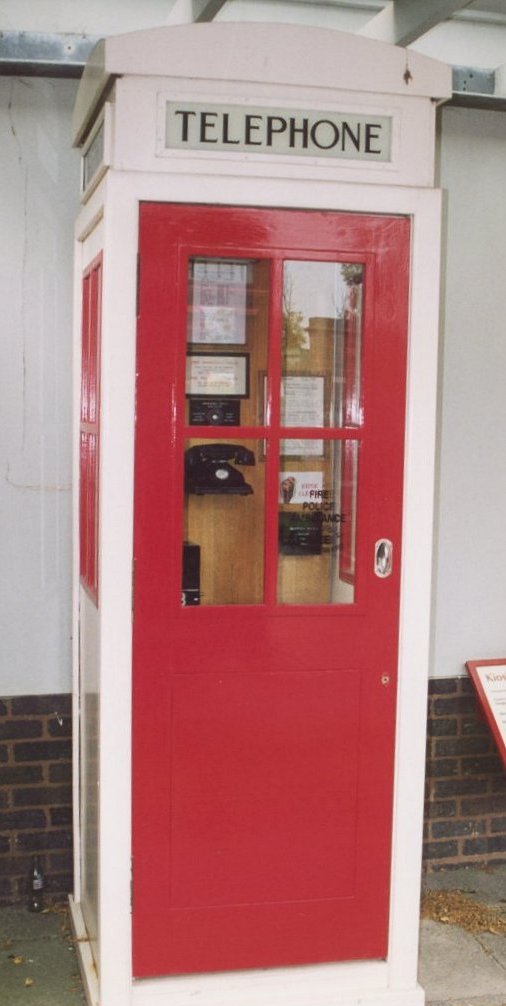
| Kiosk No. 5 [Introduced in 1934] Kiosk No. 5 (K5), introduced in 1934, was a little-known and short-lived experimental British telephone kiosk designed by the General Post Office (GPO) to address the need for a portable, temporary, and lightweight telephone box. Unlike its predecessors, which were heavy and fixed in place, the K5 was designed primarily for temporary installations—such as exhibitions, fairs, or military use—rather than permanent street furniture. It was created to be assembled and disassembled quickly, with portability as its central design objective. The K5 was used in a few select locations across the UK, most notably during British Empire Exhibitions, and other large public events where temporary infrastructure was required. Due to its lightweight nature and limited deployment, there were no significant overseas installations, and it was never exported in any notable way. Today, only one known original example of the K5 survives, which is housed at the Avoncroft Museum of Historic Buildings in Worcestershire, home to the UK’s National Telephone Kiosk Collection. It is considered an extremely rare and fragile example of 1930s GPO design. The K5 was designed not by Sir Giles Gilbert Scott but by Post Office engineers, with functional concerns rather than classical beauty in mind. It was constructed using painted plywood panels mounted on a steel or timber frame, making it much lighter than the cast-iron or concrete kiosks before it. This made it cheap to produce and easy to transport but much less durable. The standard colour was red, consistent with other GPO kiosks of the era, and it retained white “TELEPHONE” signage in simple panels, though without embossed crowns or ornamental features. Interior lighting was fitted when electrical connections were available, though in many cases the kiosk operated without internal light. The K5 had modest dimensions, comfortably fitting one person but with little space beyond the essentials. It was reasonably ergonomic, with a standard-sized door and full-height glazing panels on some sides. However, the lightweight materials made it prone to warping, leaks, and poor sound insulation. Ventilation was minimal, and the box offered little protection from the elements. Because it was a temporary unit, it was never intended to withstand extended exposure to the British climate, and maintenance was effectively impossible after repeated use. The kiosk originally housed Button A/B coin-operated telephones, the standard of the time. In some deployments, it may have been fitted with handsets connected directly to a switchboard for events or internal networks. Deployment was managed directly by the GPO, usually in partnership with event organisers or local authorities, depending on the purpose. Politically, the K5 reflected the interwar period’s push for flexibility and mobility in public services, particularly during economic strain and national events. Culturally, the K5 did not achieve iconic status. It was never widely photographed or romanticised and does not feature in popular media or tourist iconography. Nonetheless, it remains of interest to historians and design scholars as an example of utilitarian British design during the interwar years. There was never a public campaign for its preservation because so few were produced and even fewer survived. There is no known record of K5s being exported, and no replicas have surfaced in international locations. |
 Pay phone Story
Leave a comment