| Name | Pegasus Phones |
| Date | late 1990s – 2000s |
| Manufacturer | Various, Landis & Gyr |
| Usage | Private payphones |

| Further notes |
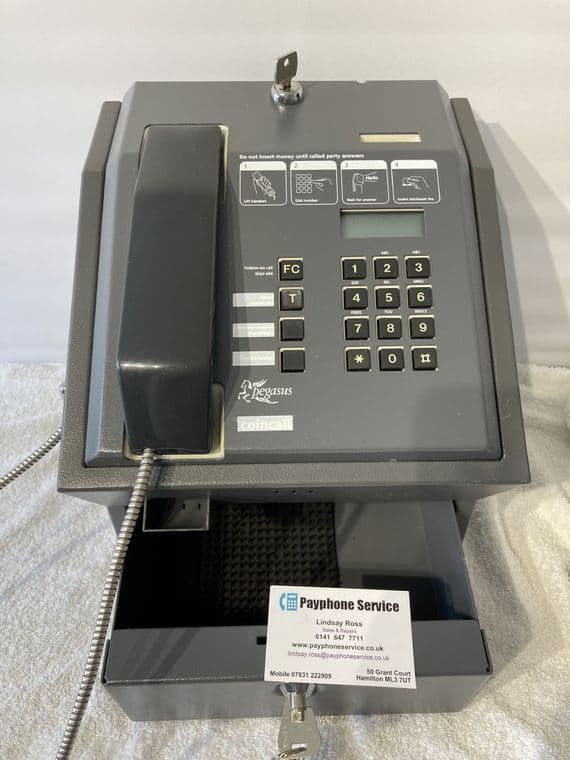
| Pegasus Payphones was a UK-based independent payphone operator that emerged in the late 1990s and early 2000s, following the deregulation of the UK telecommunications market. Like other Alternative Payphone Providers (APPs), Pegasus operated outside of BT’s monopoly and was licensed by Oftel (now Ofcom) to install and maintain public payphones. 📞 Overview of Pegasus Payphones Ltd Company name: Pegasus Payphones Ltd Active period: c. late 1990s – 2000s Headquarters: UK (precise office location details are scarce) Market focus: Alternative public telephony services, especially in high-footfall non-BT locations 🔢 Deployment Numbers & Types Estimated payphones deployed: Hundreds, possibly over 1,000 at peak, though not on the scale of Mercury or BT. Types of locations: Pubs and clubs Shopping centres Convenience stores Transport hubs (less common than BT) Seaside resorts and caravan parks Student accommodation and university campuses These phones were usually card-and-coin operated or coin-only, depending on location, and often installed in places where BT had little incentive or had removed payphones due to unprofitability. 🏙️ Locations Pegasus payphones were distributed across England, Wales, and parts of Scotland, often in: Inner-city urban locations Working-class pubs and bars (where phone usage remained high post-BT withdrawal) Tourist-heavy coastal areas Secondary or less competitive areas not saturated by BT or other APPs 📟 Hardware & Style Pegasus did not manufacture their own hardware. Instead, they used third-party payphone units, often: Solitaire payphones (manufactured by Hall Telephone Accessories) Sovereign or Contour-style models Rugged stainless steel or aluminium enclosures suitable for semi-public and indoor environments Payphones were often branded with a Pegasus logo, sometimes featuring a stylized winged horse motif. 🎭 In Popular Culture Pegasus payphones have not featured prominently in mainstream popular culture, but: They are sometimes seen in British TV shows or films set in pubs or public houses from the early 2000s. Payphone enthusiasts and urban explorers have documented them in online forums and Flickr archives, especially as they disappeared over time. They were part of the wider narrative of deregulation in the UK, with companies like Itel, Nuphones, Spectrum Interactive, and others. 🧾 Fate of the Company By the 2010s, mobile phone usage had surged, and most APPs, including Pegasus, ceased operations or were absorbed into larger service companies. Many of their payphones were decommissioned or left abandoned, later removed by local councils or landlords. 🧠 Trivia Pegasus was one of dozens of independent providers given a license under Oftel’s Public Call Box scheme, allowing them to offer local callbox services. Unlike Mercury, Pegasus did not build an independent national network — they used BT or leased line infrastructure. |
 Pay phone Story
Leave a comment