| Name | Audioline 2121, CLD60, Tel33, AUB1 |
| Date | late 1980s to early 2000s |
| Manufacturer | Agitelco, Landis & Gyr |
| Usage | hotels, shops, hostels, reception areas, and other supervised environments |

| Further notes |
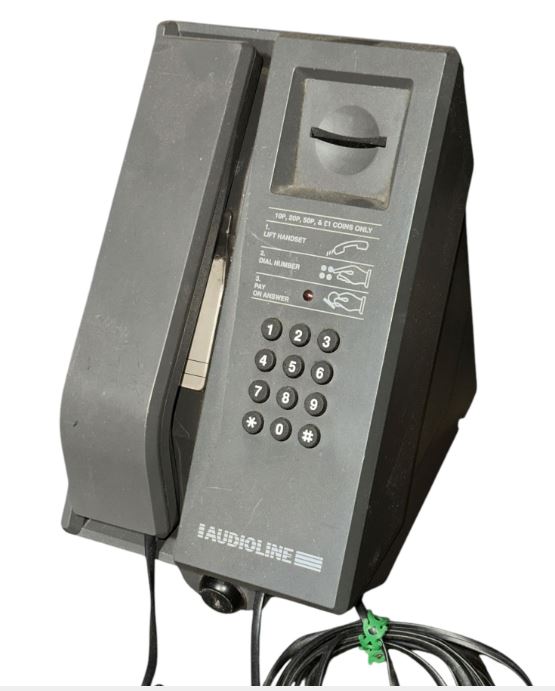
| AUDIOLINE The Audioline branded payphones (such as the Audioline 2121, CLD60, Tel33, AUB1, etc.) produced by companies like Agitelco, Landis & Gyr, or other phone makers typically do not carry a BT “CT number” because they were not standard BT coin-accepting public payphones that required the Coin Telephone (CT) engineering designation for full public deployment. Audioline branded payphones were semi-commercial telephones popular in the UK and Europe from the late 1980s to early 2000s. Designed primarily for hotels, shops, hostels, reception areas, and other supervised environments, these phones were not part of the official British Telecom (BT) public network and did not carry CT numbers. Manufactured under the Audioline name by various electronics companies—including Agitelco and Landis & Gyr—these units were typically compact, plastic or metal, and often wall-mounted. Some were coin-operated, accepting multiple denominations (10p, 20p, 50p, £1), while others operated via PIN codes or prepaid phone cards. Models such as the Audioline 2121, CLD60, and Tel 33 featured LCD displays, programmable call tariffs, and keypad locks, and were designed to restrict outgoing calls or limit access to premium-rate numbers. Though rugged and practical, they lacked the heavy-duty construction and weatherproofing of true public payphones like BT’s CT-designated units. These Audioline phones were sold directly to businesses, often installed by private telecom resellers rather than the Post Office or BT. Today, they’re largely obsolete, occasionally found in older venues or sold as curiosities. Despite their niche role, they reflect the shift toward privatised and decentralised telephony during the deregulation era. |
 Pay phone Story
Leave a comment