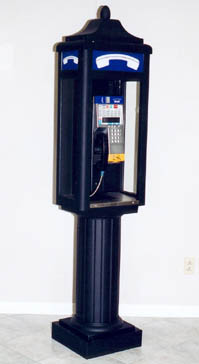
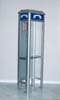
| Name | US-J-100 JARO MINOR TYPES |
| Date | c. 1980 |
| Manufacturer | Industries Jaro Inc. |
| Usage | US Phone Booth |
| Further notes |
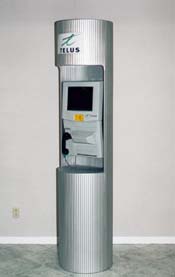
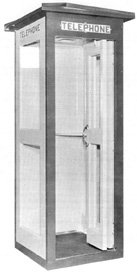
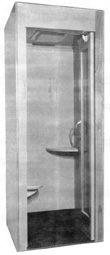
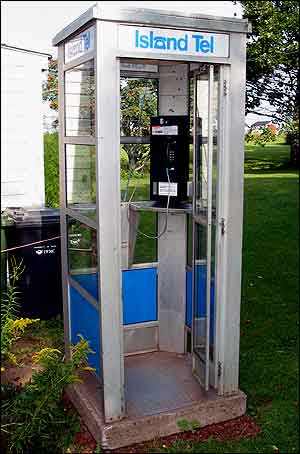
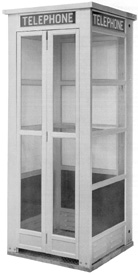
| Industries Jaro Inc. is celebrating the 50th anniversary of the first wooden payphone it manufactured, and the 40th anniversary of its first aluminium booth. “It’s a special year for us,” General Manager Jacques Caya said. The original company was founded by the late Thomas Caya. The operation supplied lumber for the residential and farm sector in the area. Caya, along with his son Hector, expanded the business to include modular building and kiosks. “We started the business in 1909, and in 1952, we made our first wooden booth,” Jacques Caya said. “We sold it to a small, small company.” It was under Hector Caya that the company started using aluminium extrusions in the construction of telephone booths. The company manufactured the aluminium booth in the 1950s, but it didn’t sell one until 1962. “Aluminium was not popular in the 1950s,” Jacques Caya said. “It was seen as a conductor, and people feared lightening strikes.” After the first aluminium boot was sold, the company found a steady customer base for its new product. “That booth, No. 600, was copied all over the world,” Jacques Caya said. “It became the famous Superman booth.” Modèle 600 Modèle 500 In 1975, Jaro Industries was spun off of manufacture telephone furniture exclusively. The company of Thomas Caya still remains as lumberyard and renovation center managed by Thomas’ grandchildren. Under the leadership of Hector’s wife Bibiane Caya, president, and son, Jacques Caya, Jaro Industries now concentrates on the manufacturing of enclosures for outdoor applications. Sister Louise and brother Roger are part of the third generation involved in Jaro Industries Inc. In 1985, Hector Caya opened Fabco Industries Inc. Fabco is in the business of manufacturing indoors cabinets, kiosks, signs and bus shelters. Since its inception, Fabco introduced the F-700 sit-down unit in 1994, the F-200 series of signs in 1995 and the F-300 series of furniture for card-only phones in 1996. In 1997 the company introduced the F-900 series of multimedia kiosks. |
 Pay phone Story
Leave a comment