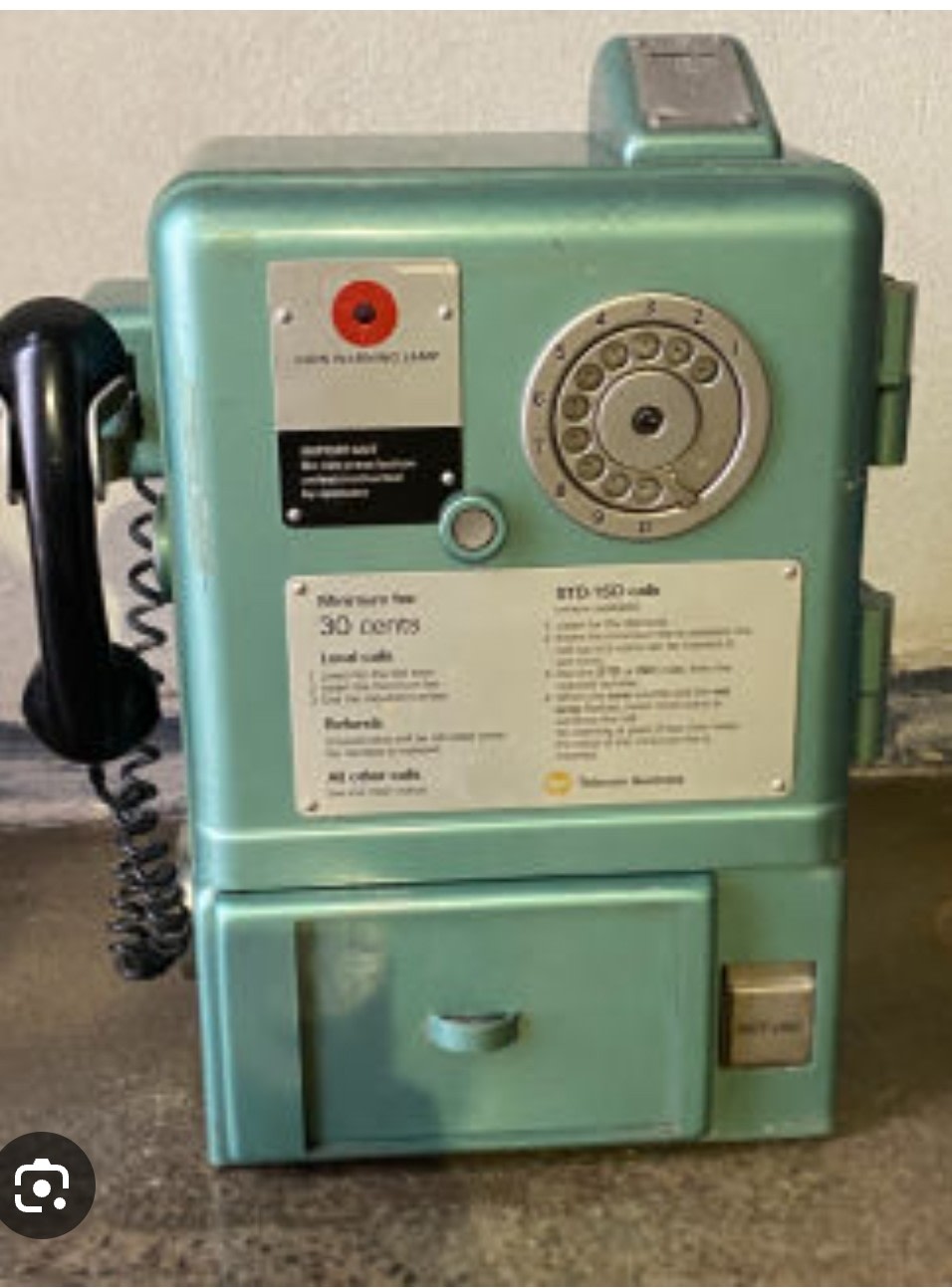
| Name | Coin Telephone 3 CT3 |
| Date | 1972, heavily adapted until c. 2005 |
| Manufacturer | Anritsu Japan, steel case developed by the Post Office Workshops in Melbourne |
| Usage | Booths and public wall mounted Installed in the CT3 Programme aluminium booth |
| Notes | the classic payphone of the ’80s, a very popular collectors’ item now. See notes below. |


Development of the PMG Coin Telephone 3 (CT3)
| Coin Telephone No. 3 Up to now, Australia did not have a public telephone capable of handling multiple-coin STD calls. In 1972 the Coin Telephone No 3 was released. It incorporated the latest electronics, courtesy of Anritsu in Japan, and an incredibly heavy armoured steel case, courtesy of the Post Office Workshops in Melbourne. A story I heard goes that the Japanese sales people were demonstrating their latest pride and joy at the Melbourne Workshops, and boasted that it was entirely vandalproof. A Workshops technician proceeded to show them that it wasn’t. He had it open in under a minute. They must have wondered what sort of vandals Australia had, but they sat down and redesigned the phone from the ground up. They used many of the vandal-proofing techniques developed in the CT1 and CT2. The result was not only a success in Australia, but Anritsu sold it worldwide.  Above- Anritsu payphone from 1979 used in Greece. From the start it could handle local calls, STD, and International dialling. I once talked to a lady from the United States who was looking for an International public phone. She found it hard to believe that she could pick up any one of these standard street phones and dial direct to her home in the U.S.A. Apparently in the U.S. there are special phones for International calls. Perhaps there is something to be said for having one controlling body like the APO. The phone was based on a model produced for Nippon Telegraph & Telephone Public Corporation, and was initially made in Japan until Australian manufacturers could be organized. When the CT3 finally hit the streets, it was so heavy (over 100 pounds) that it needed a specially-designed winch to lift it into place in the Public Telephone cabinets. As well as the armoured case and reinforced front door hinges, it featured a steel cord inside the handset cord (to stop people pinching the handset), a rather short handset cord (to stop people using the handset to break the glass in the PT cabinets), an epoxy-glued handset (to stop theft of the handset internals), a teflon-lined coin chute (to stop Superglue-covered coins being used to jam open the coin slot for free calls), a small guillotine in the coin chute (to stop the coin-on-a-string method of getting free calls), a recessed stainless steel dial (to stop the dial being broken) and a coin tin that could hold $120 of small change. Apart from the handset and cord, all fittings, even the pushbutton, were metal. As coins were deposited they were checked for diameter, thickness and magnetic properties. Bent and thin coins were rejected. It was not particularly attractive, but it worked.  Above- CT3 Griffith Taylor Building, University of Sydney, Camperdown, 1987 Even so, further improvements were made over the years. The amount of cash in the coin tins attracted a more up-market type of professional thief, They could tap into the phone cabinet’s power supply and use commercial power drills to drill out the locks from the coin safe. This was solved by mounting a transformer in the PT cabinet and dropping the available voltage. The bar that held the coin safe in place could be drilled out or dislodged by firing a bolt gun into the side of the case at the strategic spot. This was fixed by mounting a ball bearing at the end of the retaining bar, to send the drill off course. The CT3 became the mainstay of the the Post Office’s payphone system. Later, under Telecom Australia, it would be upgraded further to provide a range of new models that would keep it in use well into the twentyfirst century. Features: -Armoured steel casing and reinforced hinges -Steel-lined handset cords to prevent theft -Epoxy-sealed handsets and shortened cords to deter vandalism -Teflon-coated coin chutes and internal guillotines to foil string coin tricks -Stainless steel recessed dials and a coin tin capacity of up to $120 -Coin validation based on diameter, thickness, and magnetic signature Text- thanks to https://www.telephonecollecting.org/Bobs%20phones/Pages/AustPostOffice/Payphones.htm |
| Below- bottom right: prototype model Sydney. left: early models with plastic dial and 5c tariff. |


Leave a Reply to CT-10 Telstra Smart Payphone – Australian Payphone HistoryCancel reply