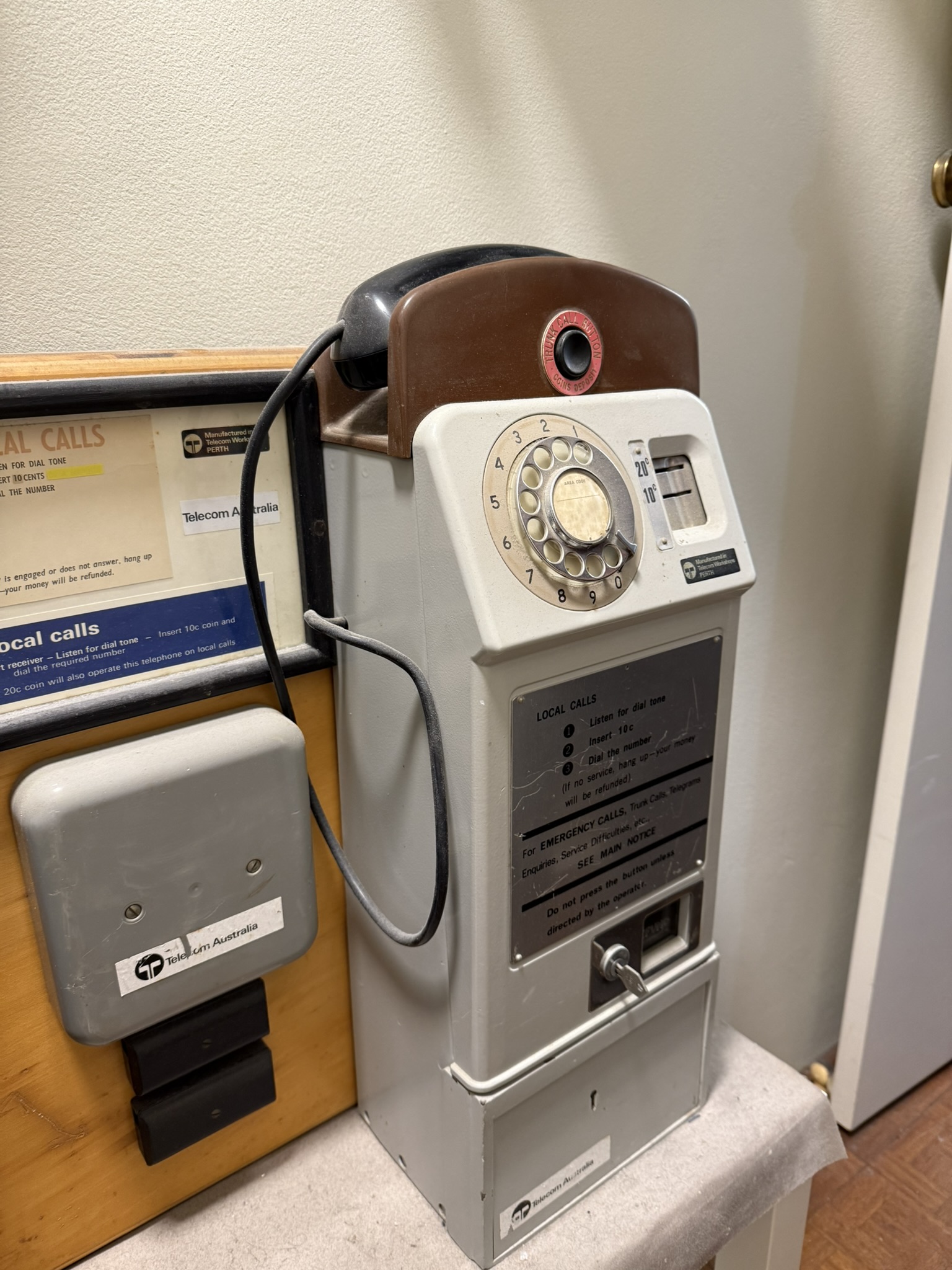
| Name | COIN TELEPHONE N0.1 (ONE BUTTON MULTI-COIN OPERATION) |
| Date | 1967-1980 |
| Manufacturer | Hall mechanism from Associated Automation, made in the UK and Japan. Similar in looks to the British Coin Telephone No. 705 and the French 700 series. Note however that the PMG CT1 was a stand alone unit. The Australian Coin Telephone No 1. works without the need for any exchange equipment. |
| Usage | Supervised location |
| Notes | These proved vulnerable to vandalism. See more notes below. |
| Resources (pdf files) | PMG CT1 TRAINING MANUAL |


Development of the Coin Telephone 1 (CT1)
| Coin Telephone No. 1 By the early 1960s, the patchwork of ageing payphones was becoming increasingly problematic. Rising maintenance demands and acts of vandalism prompted the Australian Post Office to temporarily allow private vendors to supply public telephones. Meanwhile, efforts were made to introduce a new standardized model from Britain — the Coin Telephone No. 1 (CT1). Manufactured by Associated Automation, the CT1 was launched in 1965 and trialled in Sydney, with an STD-capable version tested by 1968. Although it lacked strong anti-vandal features initially, the CT1 was intended for installation in supervised locations such as Red Phone booths and Easiphone kiosks. Its straightforward design evolved quickly: a reinforced steel diaphragm and Chubb lock were added, replacing the original simple lock mechanism. Over time, several subtle modifications were made to the model, including a change in its colour scheme — though the reason behind the colour shift remains unclear. |
| The Coin Telephone No.1 known as CT1, was manufactured by Associated Automations in Britain. and later in Japan and has similar facilities to the 2-Button Multi-Coin Telephone, but uses electronically generated tones for identifying coin insertion to the operator. It has only one button which is for depositing the coins during operator-assisted calls and has an Australian modification which acts as a deterrent to calls without coins to service 11 numbers such as “Time”, “Weather” and “Sport”. This deterrent is an oscillator which when no coins are inserted, comes into circuit during line reversal to mask reception. To overcome the need for a second button to obtain coin refund, the circuit is arranged so that refund is obtained when the user replaces the handset. Source- (with thanks to) History of the telephone in New South Wales / by Jim Bateman [Croydon, N.S.W.] : J. Bateman, 1980 ISBN: 0959478701 Below- special WA CT1 (left) and corner mounted attachment (right). |


Leave a Reply