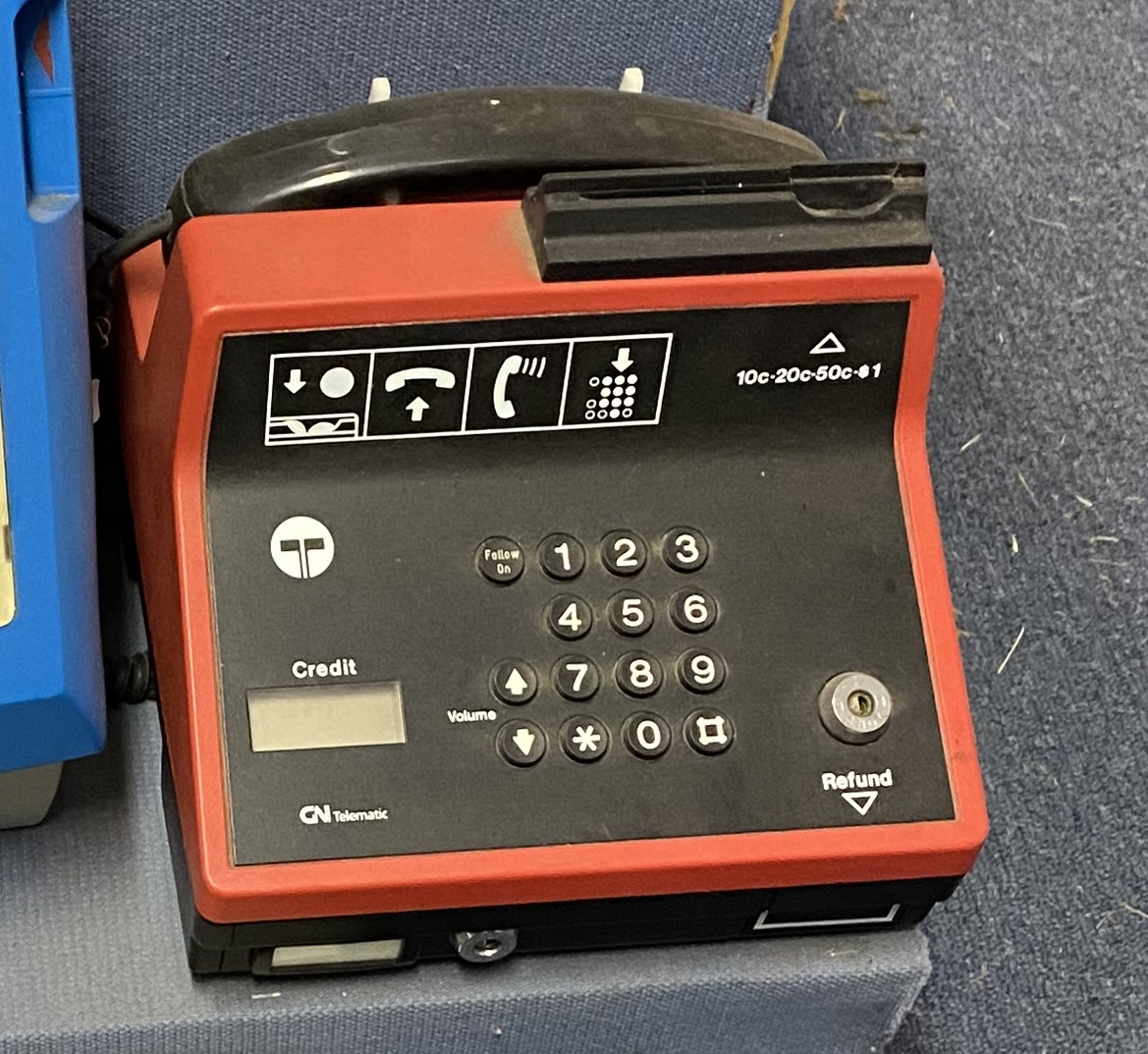
| Name | TELECOM GN TELEMATIC |
| Date | 1980. Very rare. |
| Manufacturer | Alcatel France GNT-Automatic Denmark (GN-Communication) Designer- Henning Andreasen GNT-Automatic was a Danish telecommunications equipment maker, known for telephones and payphone hardware from the mid-20th century onward. Known for its late century Scandinavian design concepts. |
| Usage | Likely a supervised, wall-mounted payphone |

Development of the TELECOM GN TELEMATIC
| The TC-01 TELECOM GN Telematic is a distinctive Scandinavian payphone dating from around 1980, reflecting a period when European manufacturers experimented with compact, supervised public telephones rather than large street cabinets. It was produced by GN Telematic, a Danish telecommunications equipment maker associated with the wider GN industrial group, which supplied telephone hardware to Nordic and European markets in the late twentieth century. The phone’s industrial design is attributed to Henning Andreasen, whose work followed the classic Danish modern tradition: restrained form, functional clarity, and durability. This influence is evident in the TC-01’s robust casing, clean geometry, and wall-mounted configuration, all aimed at resisting damage while remaining visually neutral in public or semi-public interiors. The TC-01 was likely intended for supervised environments such as clubs, institutions, workplaces, or transport facilities rather than unsupervised street use. Its design prioritised controlled access, reliability, and ease of maintenance over decorative presence. The use of the term “Telematic” reflects contemporary late-1970s and early-1980s language around telecommunications systems, rather than any digital or data capability. Overall, the TC-01 stands as an example of European payphone design at the point where public telephony was becoming more specialised, architecturally discreet, and closely integrated into interior spaces rather than freestanding urban furniture. |
| Henning Andreasen was a Danish industrial designer active primarily in the 1970s and 1980s, working at a time when Scandinavian design was shifting from domestic objects toward technical and institutional products. His work sits firmly within the tradition of Danish functionalism: restrained forms, clarity of use, and an emphasis on durability over visual flourish. Andreasen is best known for his involvement in the design of telecommunications equipment, particularly telephones and payphones produced for Danish manufacturers associated with the GN group. These products were intended for public and semi-public environments, where resistance to wear, vandalism, and misuse was critical. As a result, his designs typically feature compact wall-mounted forms, robust housings, and minimal decorative detail, allowing the object to recede into its architectural setting while remaining highly legible to users. Unlike high-profile Danish furniture designers of the same era, Andreasen’s work was industrial rather than domestic, and often anonymous in public use. His designs were tools rather than statements, shaped by operational requirements, maintenance regimes, and institutional clients. This makes his work especially interesting within the history of public telephony, where design excellence was expected but rarely celebrated. Henning Andreasen represents a strand of Scandinavian design focused on quiet competence—objects that worked reliably, looked correct, and aged without drawing attention to themselves. |

Leave a Reply