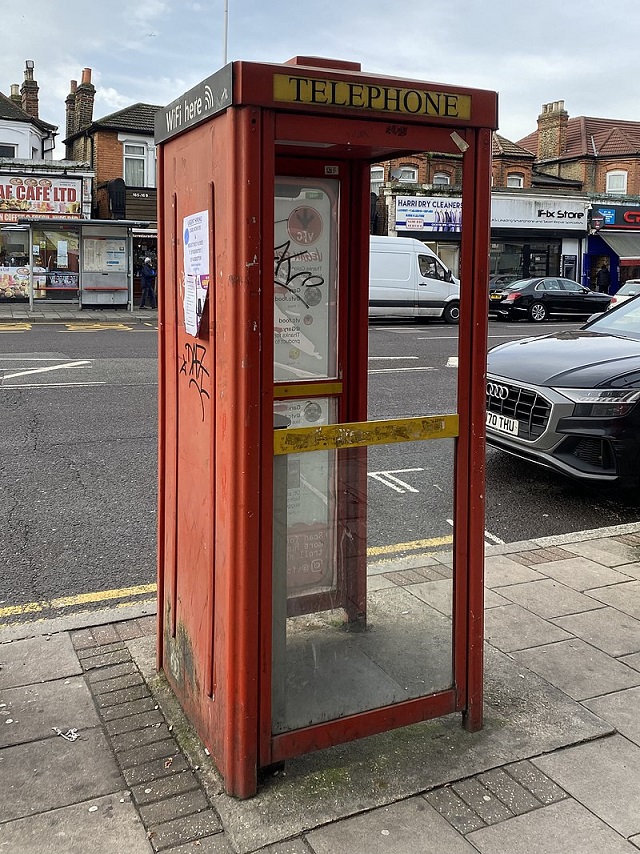
| Name | New World Kiosks |
| Date | 1988 to present |
| Manufacturer | New World. Looks like Schlumberger payphones. |
| Usage | Public call box |


Below- New World kiosk in Dublin (Lower Rathmines Road near the Swan Shopping Centre) 2026. New world payphones by Clear Channel on behalf of Eircon.

Development of New World Payphones
| New World Payphones emerged as one of the most significant independent payphone operators in the UK (and influential in Europe, including Germany’s liberalised market context) following telecom deregulation in the 1990s. The company was incorporated in 1990 and began deploying public payphones on the streets of London in August 1996. From the outset, New World operated outside the traditional monopoly systems (such as BT or Deutsche Telekom), targeting high-revenue urban locations—airports, hotels, and city centres—rather than universal coverage. By 1997 it had around 500 kiosks, expanding to over 1,200 by 1999, making it the largest independent payphone network in Britain after the decline of earlier competitors. A defining feature of New World’s operation was its flexible payment ecosystem. It issued its own telephone cards, evolving from magnetic stripe (CardLink) to chip-based (Smartz) and eventually remote PIN-based systems (TalkAround) that could be used from almost any phone. This mirrored broader European trends toward decentralised, commercially driven telephony rather than state-controlled infrastructure. Physically, New World deployed a mix of adapted traditional kiosks (notably black-painted K6 boxes in Westminster) and modern glass kiosks with integrated advertising. Over time, the business model shifted: declining call revenue due to mobile phones led to increasing reliance on advertising panels and ancillary services. In the 2000s, the company evolved into a street infrastructure provider, introducing kiosks with Wi-Fi, digital screens, and later proposals including defibrillators. It also underwent multiple corporate changes, becoming Spectrum Interactive and later associated with Arqiva. Overall, New World represents a commercial, entrepreneurial layer of payphone history—bridging traditional telephony and modern urban digital infrastructure, before the final decline of public payphones. |
| New World Payphones was a private telephone company that emerged in the UK during the 1990s, following the deregulation of the telecommunications market. It was one of several firms granted licenses to install and operate public payphones in competition with British Telecom. Their kiosks, unlike the iconic red telephone boxes, were modern, utilitarian structures made of lightweight steel or aluminium frames and polycarbonate panels. Designed for practicality, they featured flat or slightly curved roofs, basic signage, and sometimes advertising panels. The phones inside were often card-operated or dual coin-and-card models, typically sourced from overseas manufacturers. New World Payphones targeted high-traffic public areas such as shopping centres, car parks, and near transport hubs. Their aim was to offer fast, cheap installations in places where BT had removed older kiosks or where new public phones were needed. However, with the rise of mobile phones in the 2000s, usage dropped sharply. Many of the kiosks fell into disrepair, and the company eventually ceased operations. Today, a few of their payphones survive, often derelict and vandalised, mostly overlooked remnants of a short-lived era of competition. Though never iconic, New World Payphones represented a functional and transitional phase in the UK’s communication history. They have now reinvented themselves with advertising. New World Payphones is a UK-based telecommunications company that have now successfully adapted to the changing landscape of public phone use. New World Payphones survived by reinventing the role of the public payphone. Central to their success has been the strategic use of advertising integrated into their kiosk designs. Their kiosks are typically modern, slimline structures built from robust aluminium or steel frames with clear polycarbonate or toughened glass panels. Some feature backlit advertising panels or full-height advertising wraps, making them not just communication points but eye-level marketing platforms. The telephones within these booths are simple and functional — push-button, card-operated or free-call units, often offering access to emergency and charity services. Many of the kiosks are maintained to a high standard, with clean, branded designs and consistent upkeep. Rather than decline, New World Payphones has repositioned itself in the public realm, merging utility with urban advertising. Their kiosks now serve a dual role — providing essential communication services while offering prime space for commercial or public messaging. https://newworldpayphones.co.uk/ |
| Often referred to as NWP (later Spectrum Interactive, and now part of Arqiva), New World Payphones emerged in the 1990s as the largest independent payphone network in Great Britain after Mercury’s sale in 1995 Rapid rollout: NWP debuted in London in August 1996, reaching around 500 booths by September 1997—and over 1,200 by early 1999 Distinctive kiosks: They used custom styles—classic K6 boxes painted black with gold crowns in Westminster, plus modern glass–paneled red-and-yellow or black-and-yellow booths to stand out Phone cards: Introduced in 1996, including CardLink (magnetic), Smartz (chip), and “TalkAround” cards—remote cards activated via an 0800 number—allowing flexibility across private and public phones Evolution into smart kiosks Digital transformation: By the late 2010s, in partnership with Amscreen and Clear Channel/Spectrum, NWP upgraded traditional boxes into interactive “kiosks.” These offered: Free public Wi‑Fi via Virgin Media Touchscreen maps and local information Card/cash/contactless payphone Weekly maintenance and tree-planting perks Ongoing proposals: They now propose placing kiosks with advertising screens, Wi‑Fi, phones, and even defibrillators in towns like Bognor, Littlehampton, and Crewe—all under council planning applications Publications & legal rulings: Westminster Council challenged NWP’s use of kiosks mainly for advertising. In 2019, the Court of Appeal ruled that adding ad panels meant booths couldn’t automatically be deemed permitted development—they needed explicit planning approval. Below- New World Sovereign payphones previously used in train stations in Germany. |


New World- new digital street kiosks for use in the UK


Leave a Reply