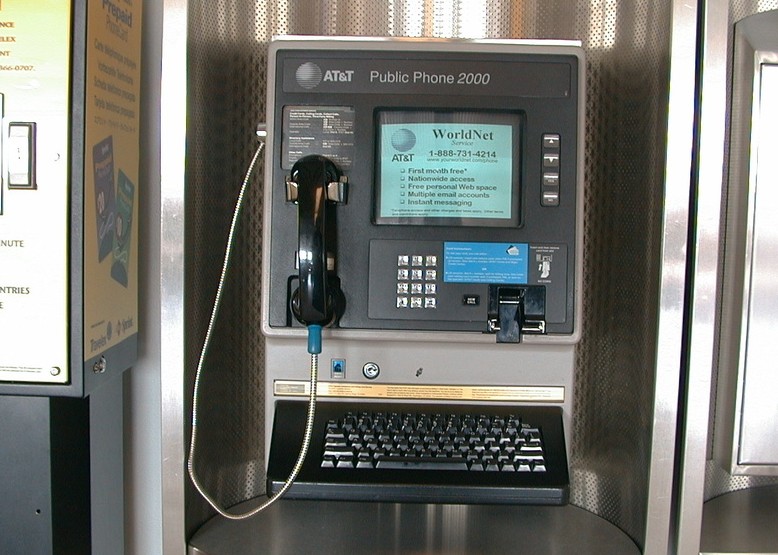
| Name | AT&T 60A- Public Phone 2000 |
| Date | 1990 |
| Manufacturer | AT&T |


Development of the AT&T 60A- Public Phone 2000
| The AT&T Card Caller and Public Phone 2000 was an advanced hybrid public telephone introduced in 1991 by AT&T, representing the peak of AT&T’s post-divestiture experimentation with intelligent, networked payphones. Unlike traditional coin-operated phones, the Public Phone 2000 was entirely card-based, accepting AT&T calling cards and credit cards, and was aimed squarely at business travellers, particularly in airports. Technically, it functioned as a “smart” or hybrid set, combining telephony with onboard computing. Early units were built around a Motorola 6809 processor and later incorporated internal hard drives, allowing them to store call data locally and dial central databases for authorization, rating, and billing. This eliminated the need for a dedicated data pair used by earlier hybrids such as the 30A and 31A. Crucially, the phones would not operate without an initial software download and continued access to AT&T’s backend systems, making them effectively unusable once those networks were retired. Physically imposing—around 80 pounds crated—the Public Phone 2000 was difficult to install but offered unprecedented features for its time: a screen, optional keyboard, email capability, limited online services, travel information, and a data port for laptop connections. Legal challenges from competitors curtailed some functions, and despite a long airport-focused deployment, the platform was ultimately overtaken by mobile phones. Its successor, the Public Phone 2000i (2000), marked AT&T’s final major statement in public payphone design. AT&T Public Phone 2000 — single-sentence answers Difference between a 30A and a 31A: The 30A and 31A were closely related hybrid card phones, with the 31A being a later, more refined variant with improved electronics and host interaction. Which phone came before this: The Public Phone 2000 was preceded by the AT&T experimental networked public terminal Public Phone 1000 (PP1000) and earlier 30A/31A hybrid sets. What this phone was used for: It was used primarily in airports and conference centers as a card-based public communications terminal offering calls, data services, email, and traveler information. What was a DMC set: A DMC set was a microprocessor-controlled payphone that relied on remote host databases for authorization, rating, and billing. What is the LIDB dip: A LIDB dip was a real-time query to the Line Information Database to validate calling cards or billing authority before completing a call. What was batch validation: Batch validation was the process of storing call records locally and uploading them later to a host system for billing and reconciliation. |
Leave a Reply