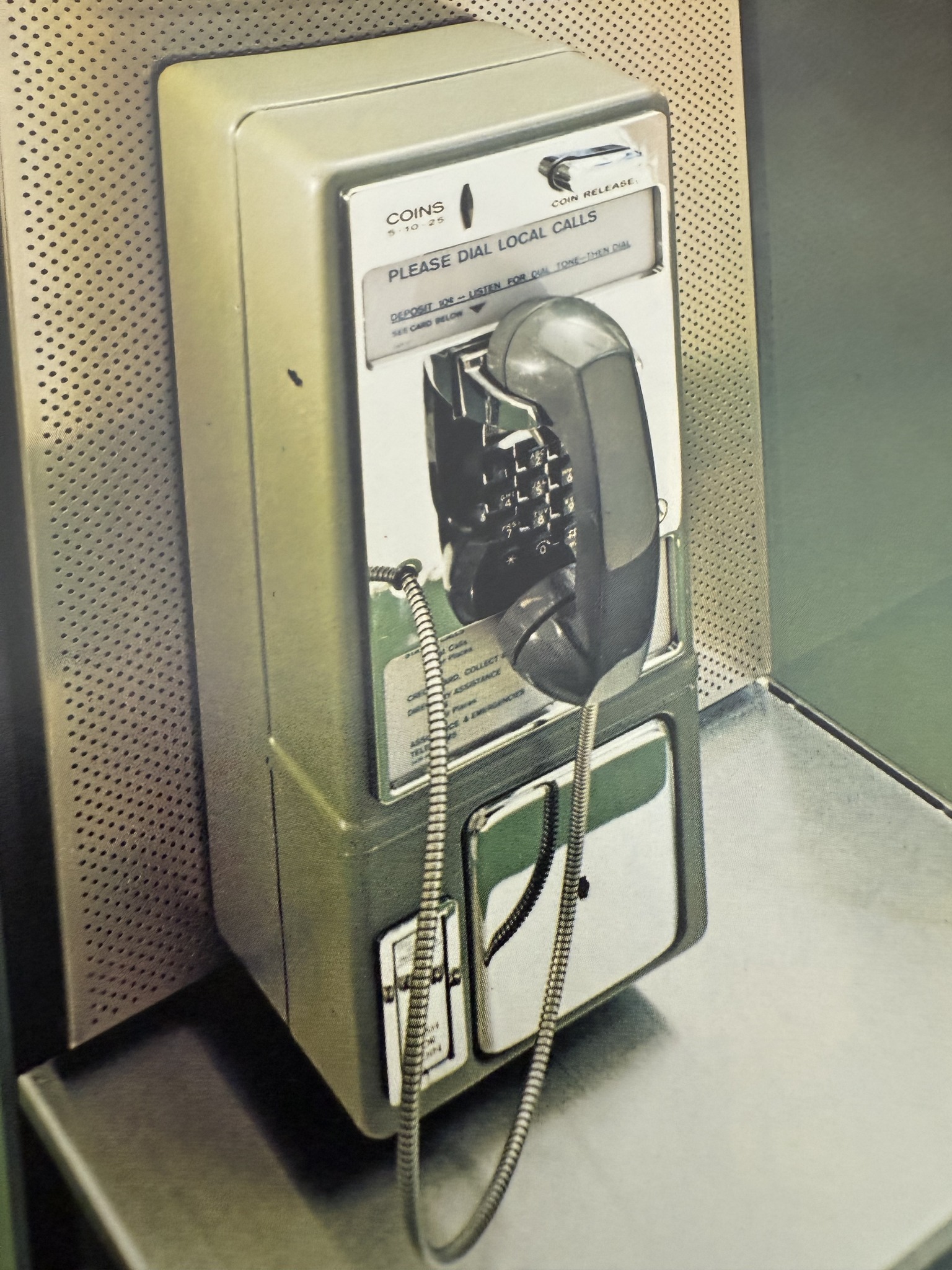
| Name | 1A2 Payphone |
| Date | 1970 |
| Manufacturer | Western Electric |


Development of the Western Electric 1A2 Payphone
| Western Electric “Fortress” Single-Slot Pay Telephone (1A1 Series) The Western Electric “Fortress” single-slot pay telephone was developed in the 1960s by Western Electric. It was subsequently maintained by AT&T, later by Lucent Technologies, and ultimately by QuorTech, a COCOT manufacturer. The Fortress represented a technical and operational improvement over the earlier three-slot payphone in two principal respects: Consolidation to a single coin slot. A heavily armoured housing and reinforced handset cord, providing enhanced resistance to vandalism and tampering. The single-slot Fortress was compatible with automated long-distance billing systems. AT&T deployed Automatic Coin Toll Service (ACTS), enabling automated coin handling and call rating without live operator intervention. Configurations Two primary installation configurations were produced: Standalone units: Models 1A1 and 1A2. Panel-mounted units: Models 2A1 and 2A2. The panel-mounted versions concealed a standard 1A1 or 1A2 chassis behind a flush metal panel for a cleaner architectural finish. Branding and Production Variants Production-era differences are identifiable as follows: 1960s manufacture: Early Bell System logo. 1970s–1984 manufacture: Updated Bell System logo. Post-1984 manufacture: No external logo. Coin return slot inscriptions varied by period: Pre-1984: “Bell System – Made by Western Electric.” Some post-1984 units: “Made by Western Electric.” Later production: No inscription. Mechanical and Physical Variations 1960s units: Tapered coin return lever. Later units: Squared-off lever profile. Pre-1990s units: Mechanical coin return assemblies (audible “ker-chunk” actuation). Later units: Electronic coin return systems (silent operation). Early or unmodified units lack an amplification button and instead display a red instructional placard describing call procedures. Both rotary-dial and touch-tone (DTMF) variants were produced. Standard finish was black; dark green examples are documented. Network Control and Later Conversions Most Fortress units were Central Office controlled, supporting local call processing, coin collect/return functions, and ACTS integration. Subsequent variants were converted to COCOT operation while retaining original Fortress housings. By the late 1990s, BellSouth (later AT&T) had converted all units in its territory to COCOT operation. Bell Atlantic (later Verizon) deployed COCOTs in areas outside its traditional landline service territory. Current Status Like most public pay telephones, Fortress units have largely been removed from service or disconnected and left in situ. |
Leave a Reply