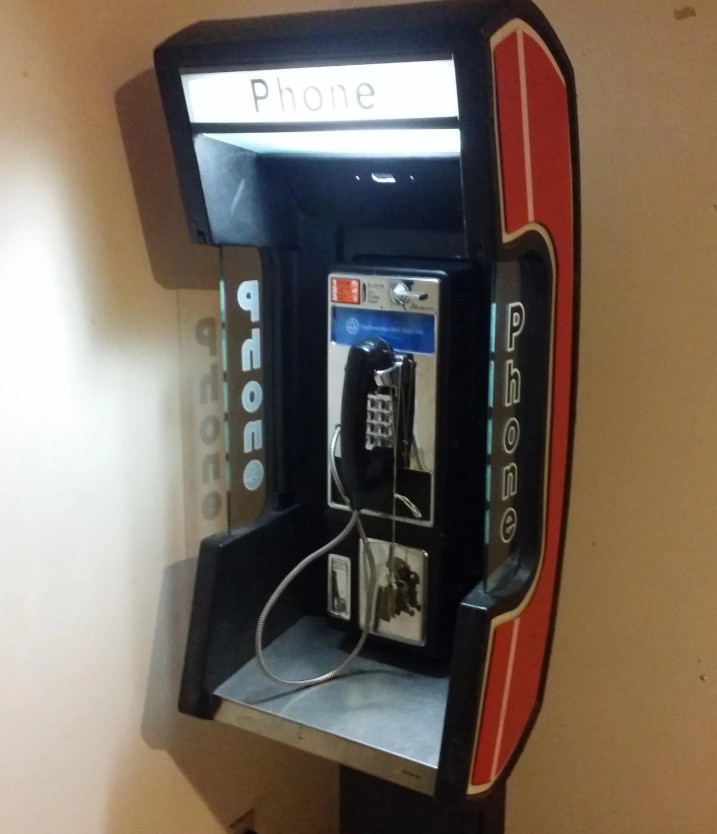
| Name | 1D2 Payphone |
| Date | 1980 |
| Manufacturer | Western Electric |


Development of the Western Electric/AT&T 1D2
| History & Description of the 1D2 Payphone Western Electric/AT&T 1D2 The 1D2 is a single-slot “dumb” payphone widely used in the 1980s in the US. “Dumb” means it has no onboard computer or modern electronics — it is essentially electromechanical. It was originally deployed by the Bell System and AT&T as the standard payphone model in many locations. The unit weighs ~50 lbs, uses a traditional mechanical coin mechanism (nickel, dime, quarter), and requires a payphone-provisioned telephone line. How It Worked Traditionally The phone provided dial tone first (unlike older models that required coins before tone). When coins were deposited, the internal totalizer sent dual-tone signals down the line (specific 1700 + 2200 Hz tones) that the phone company’s automated system (ACTS) recognized to permit connection for a timed period. This was part of the PSTN (Public Switched Telephone Network) infrastructure used by incumbent providers like AT&T/Bell to manage call billing and coin control. Comparison With Other Payphone Types Older Payphones (3-slot Rotary / Pre-Dialtone Era) 3-slot rotary payphones preceded models like the 1D2. These required users to deposit coins before dial tone would be provided — you couldn’t even start dialing until payment was made. They were largely phased out by the 1970s in favor of dial-tone-first machines like the 1D2. “Smart” (COCOT) Payphones Newer phones from the 1990s onward — often called COCOTs (Customer Owned Coin Operated Telephones) — include an embedded microprocessor board. Unlike the 1D2, these: Don’t require a special payphone line. Handle rate tables and coin logic internally. Are updated (e.g., via telnet or modem) with new rate data. Smart phones often have the coin slot on the right side and a visible circuit board inside. The 1D2’s purely electromechanical design means it is simpler but dependent on legacy signalling and provisioning. Telephone Handsets / Modern VoIP Setups The GitHub project itself repurposes a 1D2 for home use by connecting it to: An ATA (Analog Telephone Adapter) An Asterisk soft-PBX A SIP trunk (e.g., Twilio for service) This shows how old mechanical phones can interface with modern providers and VoIP systems — something impossible with original PSTN payphone provisioning without modification. Who Owned & Operated These Phones? Original Telco Providers (Incumbents) Bell System / AT&T historically owned and maintained 1D2 phones, with specialized payphone lines and coin toll service systems. Private & Independent Operators Later, independent providers and private owners — particularly after deregulation and the breakup of AT&T — began to own and operate payphones including COCOTs. |
| The term “Fortress” emerged informally in the late Bell System era to describe vandal-resistant payphones built to withstand heavy urban use. It was not an official model name for the Western Electric 1D2 payphone, but the 1D2 became closely associated with the concept. Introduced in the late 1970s, the 1D2 incorporated hardened steel housings, improved coin vault security, and tamper-resistant components. These features embodied the “fortress” idea—durable, defensive, and secure. After deregulation, independent manufacturers adopted the term commercially, but its roots lie in the design philosophy first realised in the 1D2 platform. |
| The Western Electric 1D2 is a classic single-slot, touch-tone (DTMF) payphone model from the Bell System era, known for its robust construction and electronic coin system (unlike earlier electro-mechanical models like the 1C2). Popular for conversion to home use, it often features a metal casing, rotary or touch-tone dialing, and requires specific wiring to bypass the coin mechanism for basic dial tone and calls, connecting via terminals T & R to standard phone lines. Common Uses & Conversions: Home Use: Enthusiasts often convert 1D2s for home use by bypassing the coin mechanism and connecting the “T” (Tip) and “R” (Ring) lines to a standard RJ11 jack. VOIP: Can be adapted for Voice over IP (VoIP) systems with appropriate adapters (ATA). COCOT (Customer Owned Coin Operated Telephone): Some were adapted for this purpose. Wiring for Home Use (Simplified): Locate T & R: Find the terminals labeled ‘T’ (Tip) and ‘R’ (Ring) for the incoming phone line. Bypass Coinage: The internal circuitry often needs a connector or jumper to bypass the coin validator, allowing dial tone to pass. Only if it is being used on a pay line. This is a dumb board – rates are set by a switch on the board and it is being used on a home line. ID2s will normally work just fine on a POTS line just by connecting ring and tip. The coin relay does nothing, and coins are not needed, of course, and the relay must be tied so that any coins inserted will drop beyond the escrow rather than jamming it up. However, on some later 1D2s, if you don’t set the rate switch to at least 25 cents, you will get no or severely reduced audio in the handset as discussed earlier in this thread. More than anything, I need docs for the 32c board manufactured by Elcotel for Western/AT&T. Unfortunately, it, too is 1995 technology, and I have been unable to find anything for it on the Web. The original 1D2 boards ere no problem to find docs for. Earlier 1D2s require no changes to work on POTS, other than tying the relay. This particular phone uses a Lucent 61M1PF keypad in conjunction with the 32C board. We have noticed there is a large square chip missing from the keypad, and without a spare to try as a replacement, are wondering if the fact the pad has the empty socket may explain why it has no audio or touch tones. |
Leave a Reply