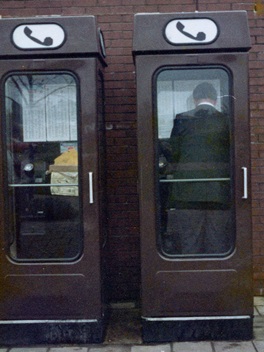
| Name | K8-Style GRP Portable Telephone Kiosk |
| Date | Manufactured 1972-75 |
| Manufacturer | Wales and Marches Telephone Board (Swansea Area) in collaboration with Morgan Marine of Llandybie |
| Usage | Public call box |


Development of the K8-Style GRP Portable Telephone Kiosk
| GRP “K8-Style” Portable Telephone Kiosk (1972) This glass-reinforced plastic (GRP) telephone kiosk, produced from 1972, was designed as a lightweight alternative to the cast-aluminium K8 kiosk. Although it resembles the K8 in overall form, it was never given an official Post Office “K” designation. The kiosk was developed by the Wales and Marches Telephone Board (Swansea Area) in collaboration with Morgan Marine of Llandybie, with the aim of creating a portable and vandal-resistant kiosk that could be easily transported and deployed where demand was temporary or seasonal. The design was intended for tourist areas, agricultural shows, and other locations requiring temporary communications, where a conventional cast kiosk would be too heavy or expensive to install. Being constructed from GRP rather than metal, the kiosk was much lighter and could be relocated if required. It was sometimes described as a “sledgehammer-proof” alternative to the K8. The first prototype used polycarbonate windows, but these proved too flexible. To compensate, the design briefly adopted two smaller window panels instead of a single large pane. Eventually the final production version returned to single large windows using 5 mm toughened glass, which provided sufficient rigidity and durability. Six prototype kiosks, including the smaller-window version, were trialled in March 1972 around the Swansea area. Following the trials, Morgan Marine produced an initial batch of about 30 kiosks, followed by around 100 more between 1972 and 1975. Production later expanded when Glasdon Limited of Blackpool manufactured 100 left-hand and 100 right-hand versions between 1974 and 1976, with a small number produced afterwards. The Glasdon kiosks were essentially identical to those made by Morgan Marine. Although red versions were reserved for British Telecom use, kiosks supplied to private operators could be produced in a variety of colours. Examples included a blue kiosk used by London Underground at Baker Street, brown kiosks at motorway service areas in the West Country, and cream kiosks produced for Kingston Communications (KC) in Hull in the early 1980s. The kiosks appeared in locations such as Swansea, Birmingham, Preston and Blackpool, and were particularly suited to railway stations and motorway services, where their lighter construction made installation easier than traditional cast kiosks. Two red kiosks were in use at Newport railway station during the 1980s, both located on the island platform. Around 1978–79 two yellow kiosks were produced for a travelling promotional exhibition showcasing the Autelca CT22A “Blue Payphone.” Today these GRP kiosks survive only rarely and represent an interesting experimental phase in the evolution of British telephone kiosk design. |
Leave a Reply