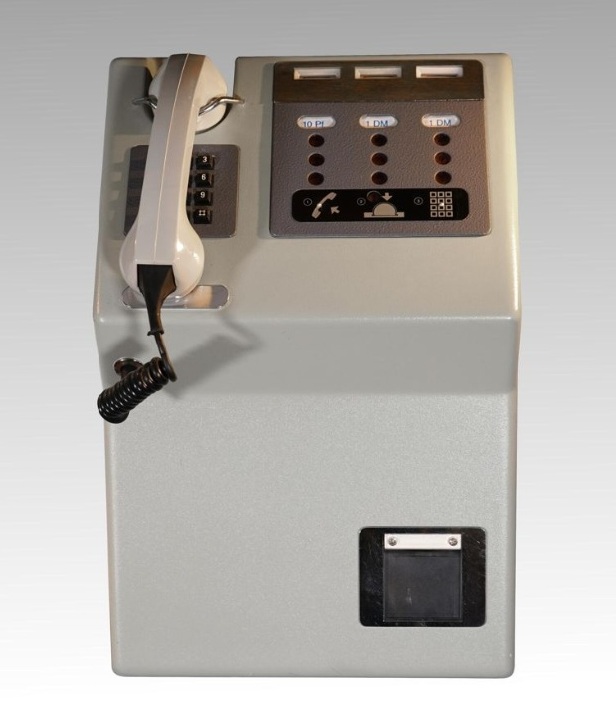
| Name | Münzfernsprecher 69 (DDR) |
| Date | 1969-92. (I remember seeing these in East Berlin in 89.) |
| Manufacturer | Deutsche Post (DDR) |


Development of the Münzfernsprecher 69 (DDR)
| The Münzfernsprecher 69 (MüF 69) was the most widespread public payphone of the German Democratic Republic during the 1970s and 1980s, representing a mature evolution of earlier models such as the MüF 60. It retained the traditional German payphone layout—separate coin mechanism, rotary dial, and handset—but introduced a more compact, integrated and robust housing suited to mass deployment and vandal resistance. Technically, the MüF 69 remained largely electromechanical, using relay-based control and a refined coin validation system that improved reliability and reduced jamming. It accepted DDR Mark coins, requiring an initial payment to access dial tone and additional coins for timed call charging. Users experienced clear physical and acoustic feedback as coins were tested, accepted, or returned, continuing the tactile tradition established in earlier German designs. Some later variants incorporated early electronic components, particularly in timing and control functions. The unit typically featured a rotary dial, though adaptations for push-button interfaces appeared later. Installed widely in kiosks, railway stations, factories, and public buildings, it was fully integrated into the state-controlled network, generally supporting local and national calls with restricted international access. Following reunification, most units were removed by the early 1990s. After German reunification in 1990, many Münzfernsprecher 69 units were temporarily adapted to accept Deutsche Mark (DM) as the German Democratic Republic network was absorbed into the West German system. It was a true trunk-capable payphone (not just local) It had a visible credit display (lamps) It used an unusual magnetic hook-switch system It bridged into the post-1990 DM transition period How the conversion worked The original coin validators were designed for DDR coins, so they couldn’t reliably accept DM coins without modification. In many cases, technicians: Recalibrated or replaced coin testing mechanisms Adjusted tariffs to match West German pricing structures Some phones were effectively “patched” rather than fully rebuilt—quick, pragmatic upgrades. Why this happened There was an urgent need to keep public telephony operational during the transition Full replacement with Western electronic payphones (card/coin hybrids) would take time The existing MüF 69 network was too widespread to remove overnight How long did this last? Only a short transitional period (early 1990s) Most converted units were rapidly replaced by modern Deutsche Telekom payphones Character of this phase It’s a bit like seeing a socialist machine briefly speak capitalist currency: Same rugged DDR hardware But now handling DM coins and Western tariffs For collectors, these transitional units—if documented—are a fascinating hybrid moment in telecom history. |
| More info- https://oeffentlichetelefone.de/ |
Leave a Reply