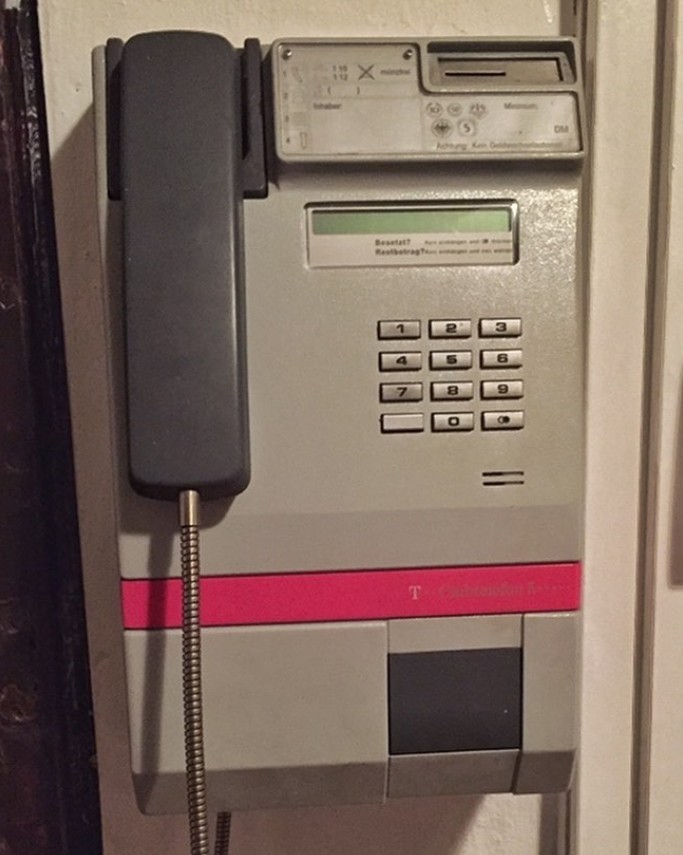
| Name | Münzfernsprecher Clubtelefone 5 |
| Date | 1995. Various versions (from analogue to ISDN) |
| Manufacturer | Deutsche Telekom produced by FMN – Fernmeldetechnik Nordhausen GmbH |


Development of the Münzfernsprecher Clubtelefone 5
| The Münzfernsprecher Clubtelefon 5 was a late-generation German indoor payphone produced by FMN (Fernmeldetechnik Nordhausen GmbH), first introduced in July 1995. It represents a highly adaptable and technologically mature stage in the evolution of the Clubtelefon series. The analogue version was manufactured until 2001, after which only ISDN variants continued, extending its service life into the 2000s. Designed for semi-private, revenue-generating environments such as pubs, hotels, and hospitals, the Clubtelefon 5 could be converted from Deutsche Mark to Euro, accepting coins from 10 Pfennig to 5 DM, and later 5 cent to 2 euro. It used the standard 16 kHz metering pulse system or internal tariff programming, with support for both pulse and DTMF dialling. Designed for semi-private, revenue-generating environments such as pubs, hotels, hostels, and hospitals, the Clubtelefon 5 was typically installed by independent operators rather than directly by Deutsche Telekom. This allowed venue owners to participate in call revenue, continuing the established Clubtelefon business model. Technically, the unit connected to a standard analogue telephone line and utilised Germany’s 16 kHz metering pulse system to calculate call charges. Unlike earlier electromechanical Clubtelefon models, the Clubtelefon 5 employed electronic control systems, enabling accurate credit processing and flexible tariff programming. Later variants were also adapted for ISDN networks, extending its operational life into the early 2000s. Physically, it was a compact, wall-mounted unit with a durable metal housing, incorporating electronic coin validation, clear status indicators, and a secure internal coin box. Although competing designs—such as a Landis & Gyr candidate model—were proposed during development, the FMN version became the standard production unit, marking the final phase of the Clubtelefon series. The unit was wall-mounted, constructed from powder-coated aluminium die-cast with a metal keypad, armoured handset cord, and a secure coin box holding approximately 400 coins. It measured 390 × 240 × 143 mm and weighed around 8 kg. FMN also produced variants including the S500 (analogue), S550 (ISDN), and S700 (card phone), with experimental IP and GSM versions. Notably, between 2004 and 2008, a version with an integrated WLAN hotspot was available, highlighting its continued technological adaptation. Two notable variants extended the capabilities of the Clubtelefon 5 into fully public and hybrid communication roles. The Clubtelefon 5 ÖTel was a public telephone adaptation used in locations such as the Frankfurt trade fair grounds. Built on the robust metal construction of the ISDN model, it incorporated an external coin safe system, with a chute beneath the phone directing coins into a separate secure container. This reduced vandalism risk, as theft attempts targeted the safe rather than the handset unit itself. The system used the same cassette extension as the Münztelefon 23 and retained an interface for accessing stored data. Interestingly, it shared the physical housing of the WLAN version, including the rear “backpack” module, though without active electronics. Unlike most Deutsche Telekom public payphones, it did not require a separate power supply beyond the NTBA and supported remote maintenance via a Telekom-specific system. The Clubtelefon 5 WLAN variant (2004–2008) represented a significant technological step, integrating public internet access. It featured a dedicated WLAN button and an integrated printer that issued login credentials after payment. A rear-mounted module housed the transmitter and control electronics, with antennas concealed behind the magenta Telekom branding. This version required additional power and modified software, allowing it to function both as a payphone and a coin-operated Wi-Fi hotspot. |
| More info- https://oeffentlichetelefone.de/ |


Leave a Reply