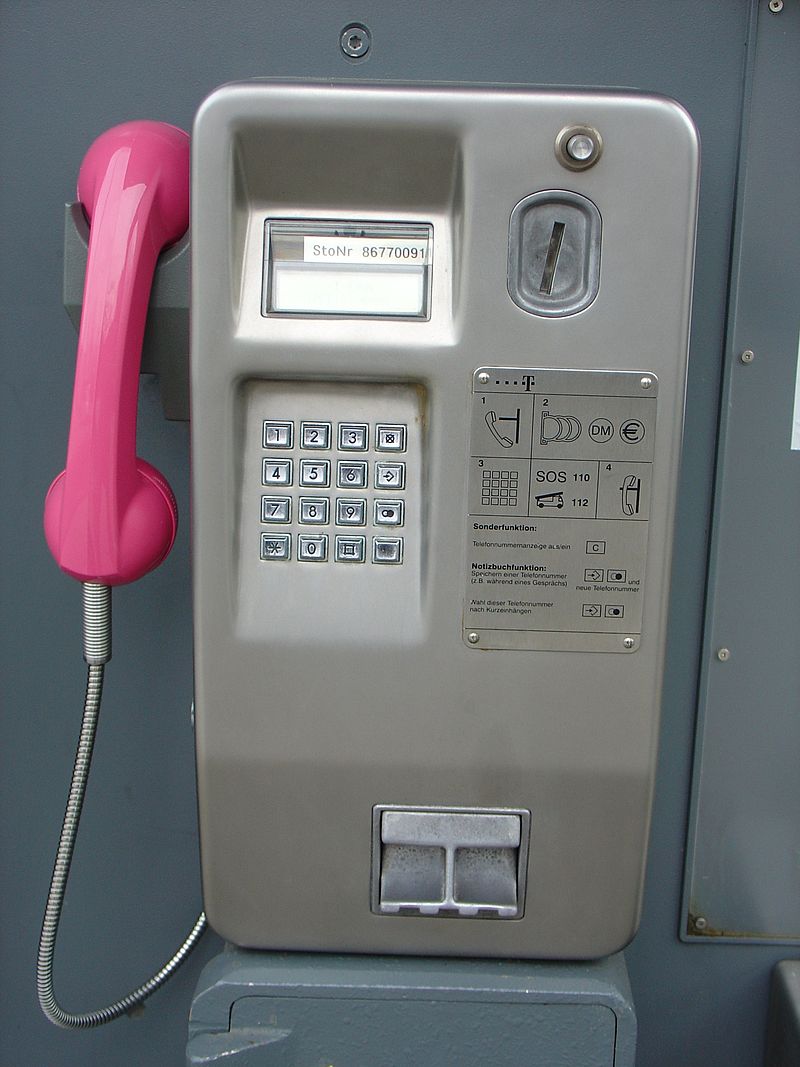
| Name | Münztelefon MT23 |
| Date | 1992 |
| Manufacturer | Siemens AG for Deutsche Telekom |


Development of the Münztelefon MT23
| The Münztelefon MT23 was introduced in 1992 by the Deutsche Bundespost Telekom as a fully electronic, software-controlled public payphone. It marked a major shift from earlier electromechanical designs to digitally managed systems and became one of the standard street payphones in Germany throughout the 1990s. Designed for analogue connections, the MT23 used the German 16 kHz metering pulse system to calculate call charges. At its core, it combined several integrated subsystems, including coin validation, storage, processing, and a central control computer. The phone featured an electronic coin validator, a temporary coin storage unit that tracked inserted credit during calls, and a microprocessor-based control system that managed all operations. A key innovation was its remote monitoring and maintenance capability. Through an integrated modem, the MT23 could automatically report faults, coin box status, or tampering attempts to a central management system (BlueS), allowing configuration updates and diagnostics without on-site intervention. Physically, the MT23 consisted of a main device unit and a separate coin cassette module mounted below, improving security and servicing. It also featured a backlit display, vandal-resistant keypad, and modular internal components. The MT23 later formed the basis for successor systems such as the BluePhone, marking a key transitional step in modern public payphone design. The Münztelefon MT23 was manufactured by Siemens AG, which at the time was the primary supplier of public payphone systems for the Deutsche Bundespost Telekom (later Deutsche Telekom). Siemens was responsible for much of the transition from electromechanical to fully electronic coin telephones in Germany during the late 1980s and 1990s. In addition to the MT23, Siemens produced a number of related and successor models, including: Münztelefon MT20 / MT21 / MT22 – earlier electronic coin telephones that introduced microprocessor control and modular construction, leading up to the MT23. Münztelefon MT24 / MT25 – later refinements with improved electronics, displays, and compatibility with evolving network systems. BluePhone (BluePay series) – a major successor platform in the late 1990s and 2000s, supporting both coin and card operation, with advanced remote management and modernised design. Kartentelefone (card phones) – including chipcard-based public telephones that operated alongside coin units, particularly during the transition to cashless payment systems. Siemens also worked closely with Deutsche Telekom on system integration, including remote monitoring platforms such as BlueS, which allowed centralised control and diagnostics across large payphone networks. Overall, the MT23 sits within a broader Siemens lineage of increasingly sophisticated public telephones, bridging traditional coin systems and the later networked, software-driven payphone infrastructure. |
| More info- https://oeffentlichetelefone.de/ Below- very interesting model BTE60 from Sodeco and Landis and Gyr in 1985. Similar housing. |

Leave a Reply