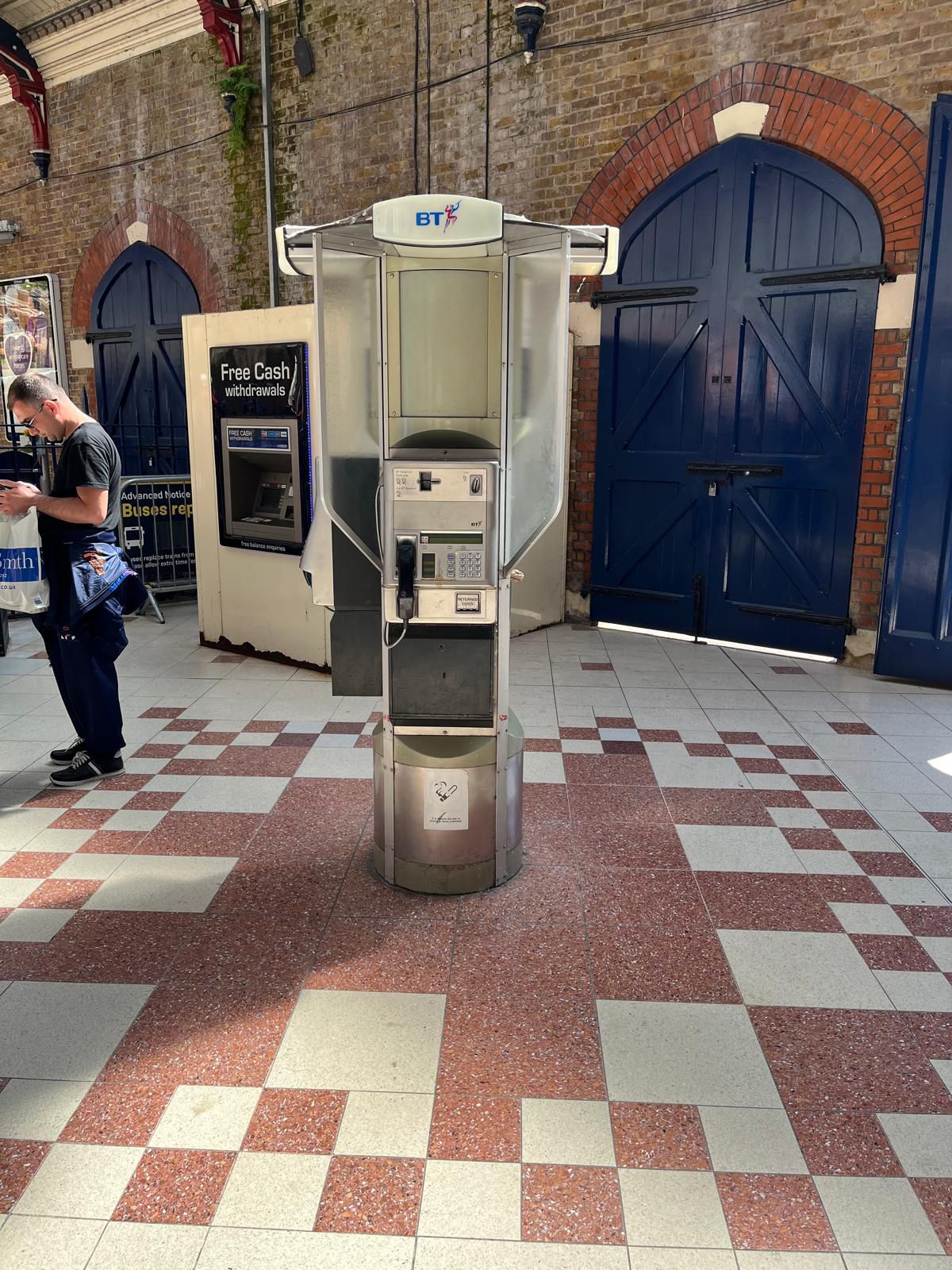
| Name | KX571 Phone Box |
| Date | c.late 1980s. Still in service in 2026 in railway stations. |
| Manufacturer | BT |


Development of the KX571 Phone Box
| The KX571 was a British Telecom open-style payphone enclosure introduced during the late 1980s as part of the shift away from fully enclosed kiosks toward lighter, more flexible street furniture. Unlike earlier kiosks such as the K6 or K8, the KX571 was typically a three-sided shelter rather than a fully glazed box, offering partial weather protection while reducing cost, vandalism risk, and maintenance requirements. Its design followed the broader KX series language—functional, modular, and understated—with a metal frame and toughened glass or polycarbonate panels. The roof was usually flat or gently angled, and the unit was often finished in standard BT colours of the period, including red or later grey tones. Internally, it accommodated wall-mounted payphones such as the Payphone 7000 series or similar electronic units, reflecting the transition from coin-heavy electromechanical systems to more modern digital payphones. The KX571 was commonly installed in lower-density urban and suburban areas where a full kiosk was unnecessary. Its semi-open form improved visibility and passive surveillance, aligning with late-20th-century urban design thinking around safety and anti-vandalism. While never as iconic as earlier kiosks, it represents an important stage in the evolution of British public telephony—where enclosure gave way to accessibility, economy, and durability. |


Above- KX530 and KX560
Leave a Reply