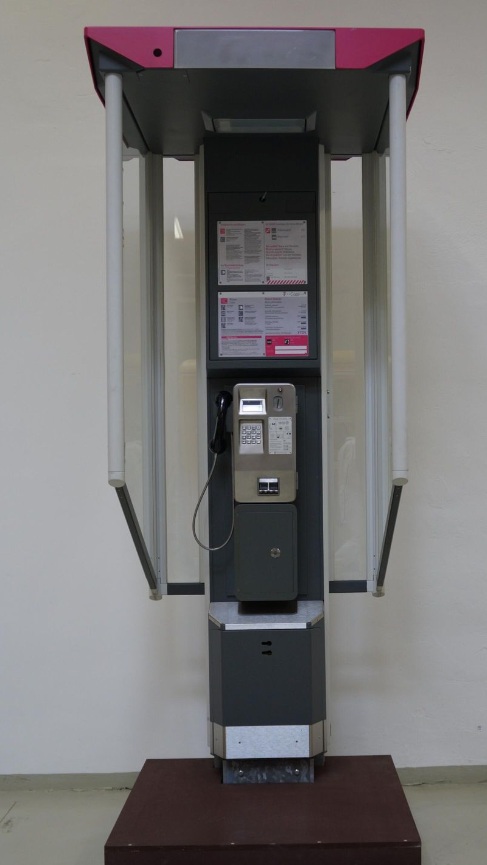
| Name | Fernsprechhäuschen 90 |
| Date | 1990 |
| Manufacturer | Deutsche Bundespost |

Development of the Fernsprechhäuschen 90
| For use in transport areas, etc. The Telefonhaube TelHb 90 was a late-generation German public telephone structure, introduced in the 1990s as part of Deutsche Telekom’s move away from traditional enclosed booths. Rather than a full “Telefonhäuschen,” it was a telephone hood (Haube)—a partially enclosed unit designed to provide basic shelter while remaining open and accessible. This design reflected changing priorities in public telephony. Fully enclosed booths were increasingly seen as expensive to install and maintain, and were prone to vandalism and misuse. The TelHb 90 addressed this by offering a simpler, more durable, and more visible alternative, while still giving some protection from rain and wind. Physically, the TelHb 90 was compact and utilitarian, constructed from metal and plastic components and finished in Deutsche Telekom’s white, grey, and magenta colour scheme. It typically measured just over a metre wide and stood over two metres high, with a weight of around 430 kg. The open-fronted form improved accessibility and reduced maintenance issues compared to earlier enclosed kiosks. Technologically, it accommodated both coin-operated telephones (such as Münztelefon 23) and card-operated systems (ÖKartTel), reflecting the transitional nature of the period. The TelHb 90 represents one of the final stages in the evolution of German public telephony—prioritising efficiency and practicality just before widespread mobile phone adoption made such infrastructure largely obsolete. |
Above-
Leave a Reply