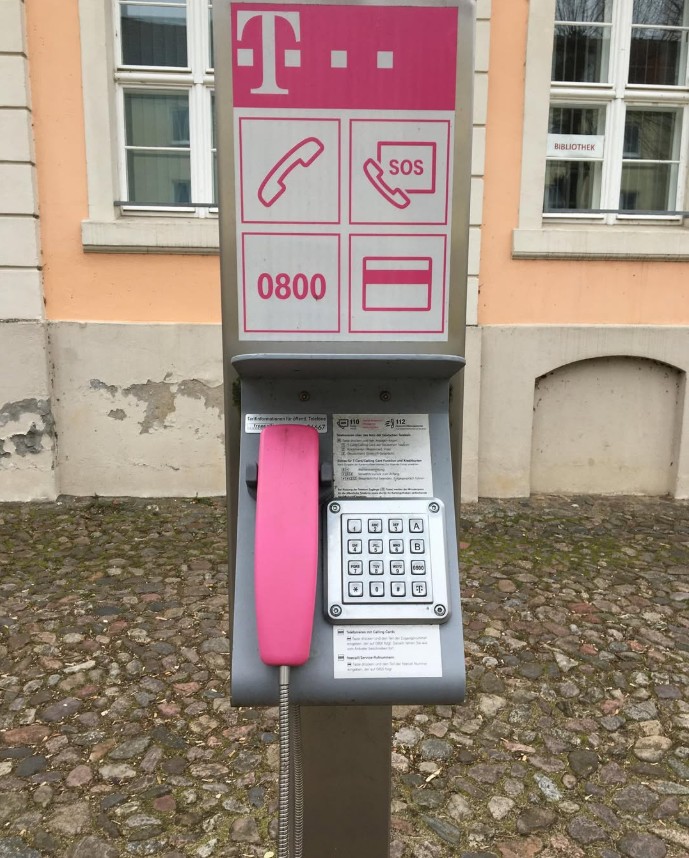
| Name | Roadside emergency call pillar (Notrufsäule) |
| Date | 1995 |
| Manufacturer | Deutsche Telekom |


Development of the Deutsche Telekom roadside emergency call pillar (Notrufsäule)
| The Deutsche Telekom roadside emergency call pillar (Notrufsäule), late 1990s–early 2000s generation, rather than a standard kiosk or payphone. These units formed part of Germany’s nationwide SOS roadside network, originally developed for motorists before mobile phones became widespread. Earlier systems (from the 1970s) were simple “flap-lift” auto-dial units, but your example is a later, upgraded type featuring a keypad and handset, allowing more flexible calling while still supporting direct emergency routing. Likely model / type There isn’t a clean “FeH-style” designation, but these are generally associated with: Telekom Notrufsäule (Type 90s generation) Often paired with Bosch Telecom or similar public telephone hardware (ÖKart-era electronics adapted for emergency use) Identifying features Magenta handset and “T” branding → post-privatisation Telekom era (after 1995) SOS + 0800 + card icons → emergency + free service integration Metal housing with hood → weather protection, vandal resistance Direct network connection → no coins required Operation Calls routed to a central response centre Could connect to breakdown services, police, or emergency operators Designed for reliability over convenience Are they still in use? Some are—but most have been phased out or decommissioned due to near-universal mobile coverage. Summary The photographed unit is a Deutsche Telekom roadside emergency call pillar (Notrufsäule) from the late 1990s to early 2000s, representing a later generation of Germany’s nationwide SOS telephone network. Unlike traditional enclosed phone booths, these were open, pole-mounted devices designed specifically for emergency and assistance calls, particularly for motorists. Earlier versions from the 1970s used simple flap-activated automatic dialling systems, but this later type incorporated a keypad and handset, allowing more flexible communication while retaining direct routing to assistance services. The design reflects Deutsche Telekom’s post-privatisation identity, with its magenta branding and simplified, durable construction. The unit typically features a metal housing with a protective hood, a vandal-resistant keypad, and a handset connected by a reinforced cord. Icons indicating SOS, free-call numbers (0800), and card usage highlight its multifunctional capability, although no coins were required for emergency calls. Technically, these pillars were connected directly to central response systems, enabling users to contact breakdown services, police, or emergency operators without needing to know specific numbers. While once widespread, the network has largely been decommissioned due to mobile phone adoption, though some units remain in limited or backup use today. |
Leave a Reply