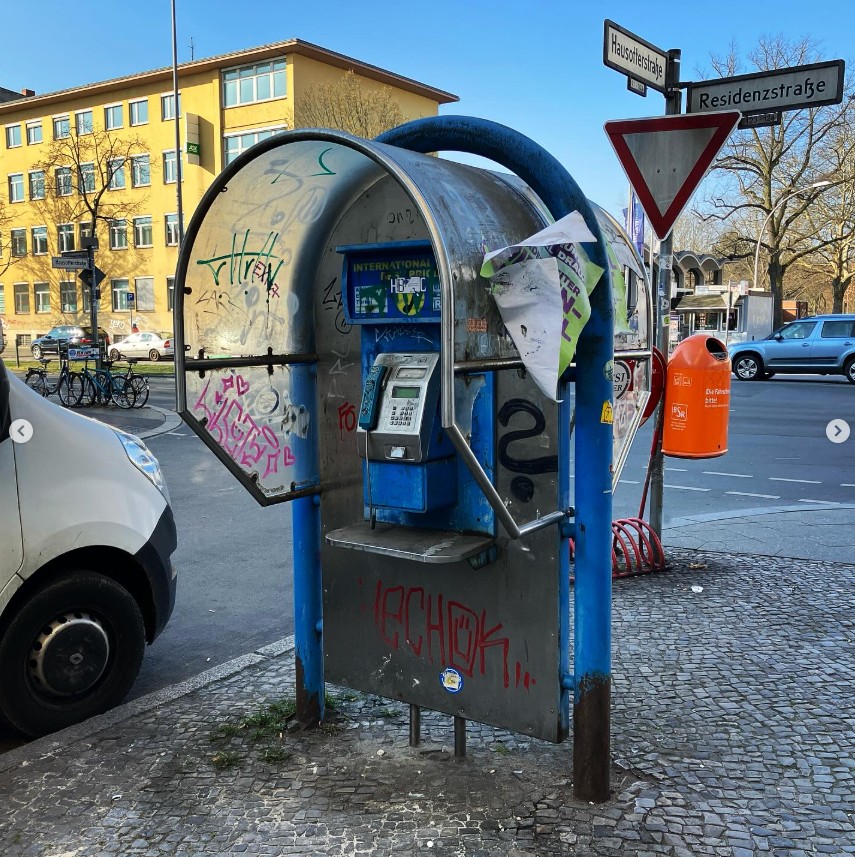
| Name | TELE-RUF Smart Payphones |
| Date | c. 2000. I have only been able to find pictures of badly damaged models before their final removals in 2025. |
| Manufacturer | MPP (multi-purpose payphone) platform originally developed by Amper in Spain, with the model being refined from large scale use by Telstra in Australia (as the standard payphone). |
| Links | Used in South Africa Link- Telstra Smart Payphone (MPP X1) (Australia) |


Development of the TELE-RUF Smart Payphones
| The TELE-RUF “Smart Payphone” was part of a late-1990s generation of privately operated public telephones in Germany, developed during telecom liberalisation. TELE‑RUF Kommunikations GmbH, founded in 1997 in Bonn, grew to become one of the three largest independent payphone operators in Germany, focusing on low-cost calling and value-added services. These “Smart Payphones” were designed as multi-functional communication terminals, offering not just cheap calls (“ab 5 Cent”) but also services aimed at mobile users, including SMS, ringtone downloads, and digital content delivery. They were effectively an attempt to bridge the gap between traditional payphones and emerging mobile communication. The hardware used by TELE-RUF aligns with internationally deployed systems, notably the MPP (multi-purpose payphone) platform originally developed by Amper in Spain, later refined for Australian use in the Telstra CT-10 Smart Payphone. TELE-RUF leveraged this robust, modular electronic design, which included coin handling, keypad input, display screens, and programmable tariffs—ideal for competitive operators. Installed in streets, transport areas, and retail zones, these phones emphasised price competition and flexibility, often advertising cheaper rates than Deutsche Telekom. However, despite their technical sophistication, TELE-RUF systems declined rapidly in the 2000s as mobile phones became ubiquitous. Overall, they represent a transitional global payphone platform, adapted locally in Germany but part of a broader international shift toward digital, service-based public telephony. |


Above-
Leave a Reply