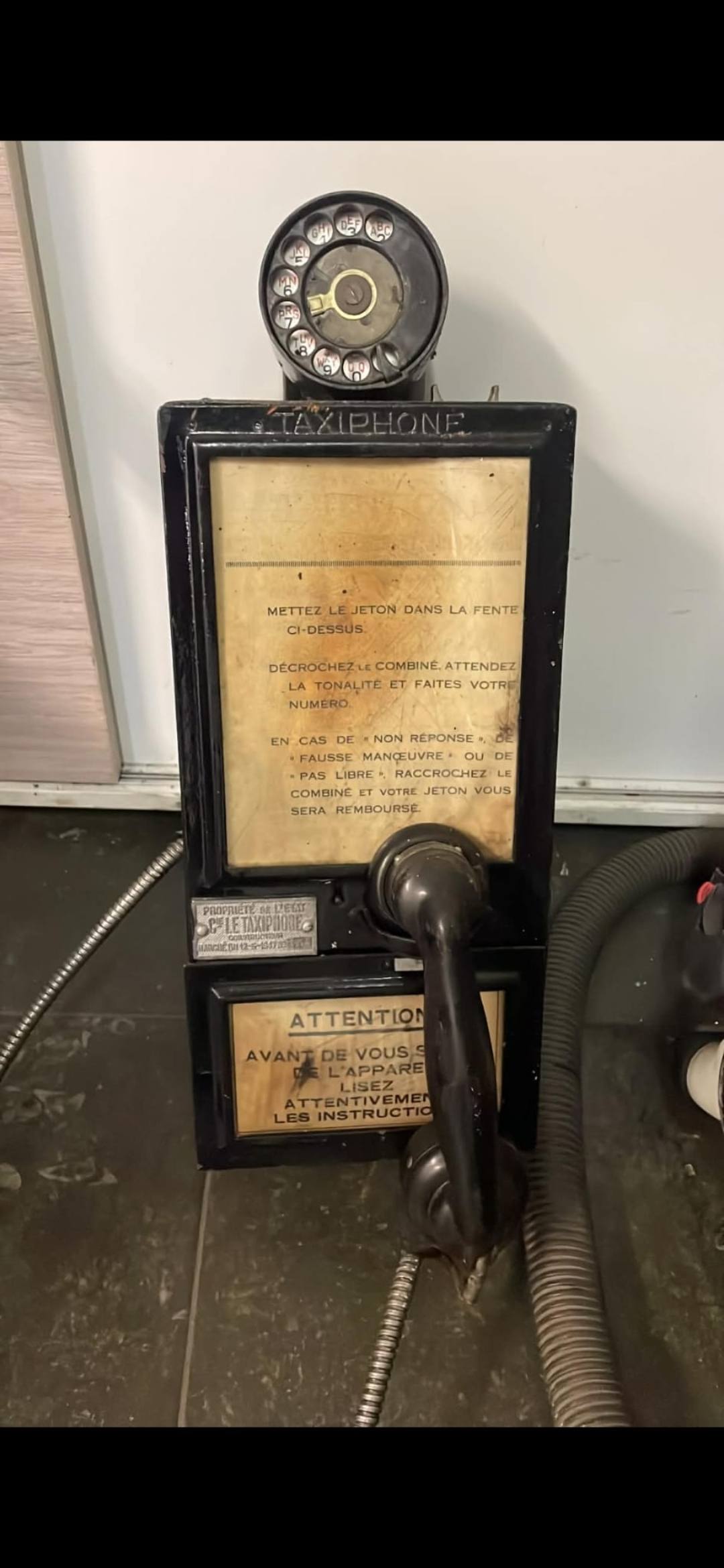
| Name | Type PARIS Hall 25 |
| Date | 1937-47 |
| Manufacturer | Compagnie le Taxiphone for PTT |


Development of the Type PARIS Hall 25
| Around 1930, France introduced the first urban payphones with dials compatible with automatic telephone networks, allowing users in large cities to make calls without operator assistance. To obtain a dial tone and place a call, users first had to insert a token or coin. These early devices could only collect one payment per call, restricting their use to local (urban) calls within the same tax district, which were not time-based. Calls to other cities via the intercity network were not permitted. These payphones used Hall technology and operated through a system known as polarity reversal taxation. When the called party answered, the telephone exchange reversed the line polarity, activating an internal electromagnet. This mechanism performed three functions: it validated and accepted the token, enabled conversation by activating the microphone, and disabled the dial during the call to prevent fraud. When the call ended and the handset was replaced, polarity returned to normal, resetting the system for the next user. All early Hall-type automatic payphones were therefore classified as urban units. Among the approved models was the Type PARIS, introduced around 1937 and used until 1947. It was a token-operated PTT payphone with a cash button and a telephone circuit similar to those used in approved post offices from 1924. Following a 1925 agreement between the P&T Administration and the Compagnie Le Taxiphone, the Type PARIS featured an innovative “monobloc” internal structure, mounted on articulated hinges and detachable, representing an advanced modular design for its time. During the early development of French payphones in the 1920s and 1930s, the jeton (token) became a practical solution to the challenges of coin-operated telephony. At this stage, France lacked a stable, standardised coin system suitable for reliable mechanical validation, particularly given variations in size, wear, and metal composition. Operators such as Taxiphone therefore adopted proprietary tokens that could be precisely manufactured to consistent specifications. These jetons were typically made of brass or similar alloys and were carefully calibrated in diameter, thickness, and weight to function with mechanisms derived from the Hall system. This ensured that only authorised tokens would pass through the validator, reducing fraud and mechanical failure. Users would purchase jetons from café owners or attendants, reinforcing the semi-private, concession-based nature of early public telephony. The use of jetons also allowed operators to control pricing independently of the national currency, simplifying tariff adjustments and avoiding issues with fluctuating coin values. However, this system required a distribution network and limited spontaneity compared to coin-operated phones. |
| More info- https://www.publiphonie.fr/ |
Leave a Reply