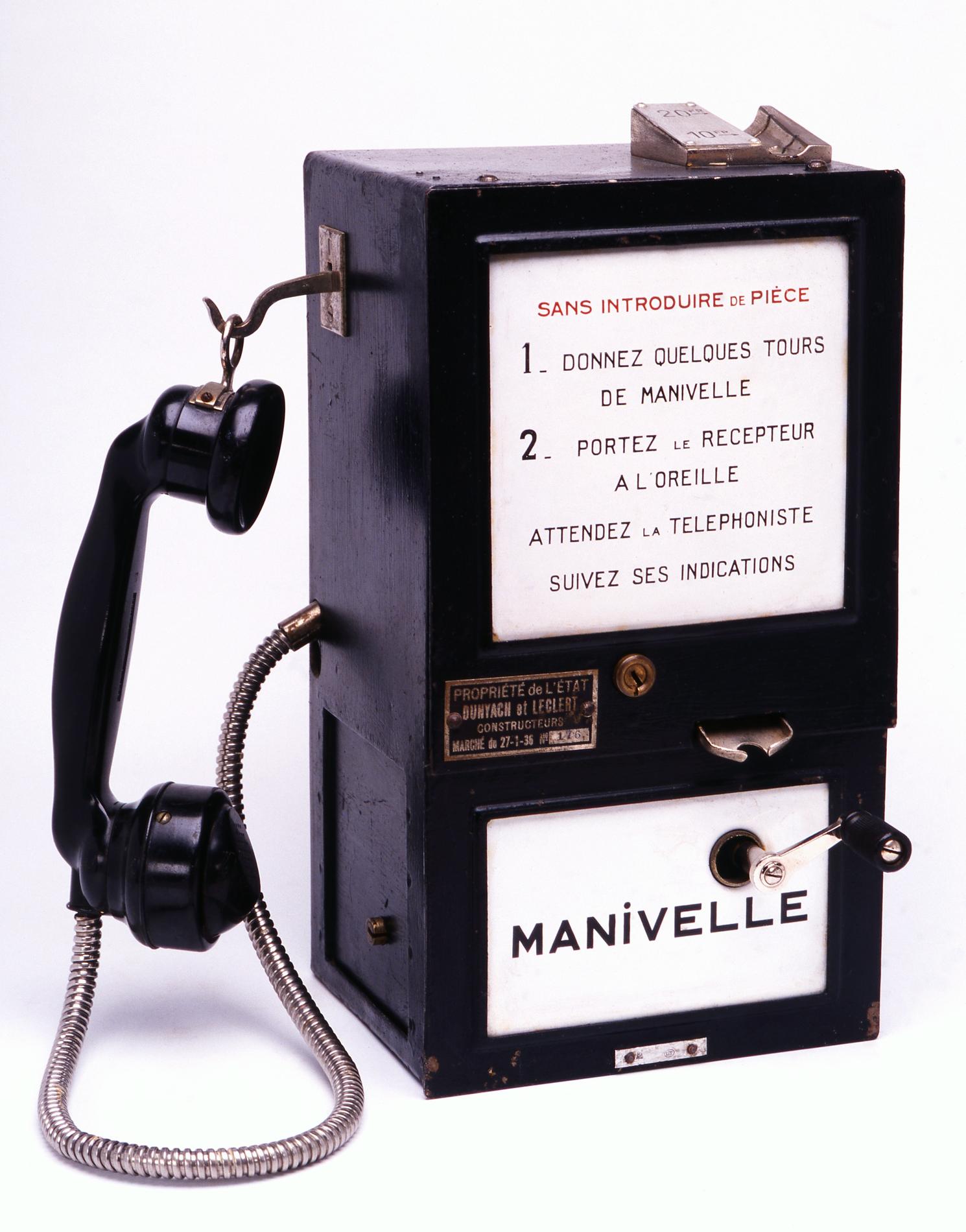
| Name | Type SAINT-CYR BL ( Batterie Locale) Type SAINT-CYR BCI (Batterie au Central Intégrale) |
| Date | The Saint-Cyr type payphones appear to have been used primarily during the interwar period, with their introduction linked to the early rollout of the Taxiphone network in the early–mid 1920s (around 1923–1925) following the concession granted to private operators. |
| Manufacturer | Compagnie le Taxiphone for PTT Note- the mechanism was based on the Hall coin mechanism developed by William F. Hall in England in 1925 |
Below- Type SAINT-CYR BL ( Batterie Locale). Magneto model for use on a local battery exchange.


Development of the
| The Taxiphone company was a private operator that played a central role in the early development of public telephony in France. Established through a concession granted by the French PTT administration in 1923, the Compagnie du Taxiphone installed and operated prepaid public telephones—often located in cafés, stations, and other public places. These early machines typically used tokens rather than coins. In the 1960s the company became SAFAA (Société Anonyme Française des Appareils Automatiques). Its long-standing concession ended around 1970, when the state resumed direct control of public telephony, replacing Taxiphone systems with the more advanced “publiphone” network. The Saint-Cyr type payphone refers to an early French public telephone installation developed under the Taxiphone system during the interwar period. Introduced in the 1920s–30s, it was part of a broader effort to expand public access to telephony before widespread household connections. The name is generally associated with installations trialled or standardised around Saint-Cyr (often linked to military or institutional sites), where controlled and robust communication systems were required. These payphones were typically wall-mounted or housed in simple booths and were designed for supervised or semi-public environments such as cafés, railway stations, and administrative buildings. Rather than coins, many Saint-Cyr units operated using tokens (Jetons), reflecting the Taxiphone company’s concession model. The equipment was relatively mechanical and durable, prioritising reliability over user comfort or privacy. Functionally, they represent a transitional stage between manually assisted public telephones and the later fully automated coin-operated systems that became widespread after World War II. Their deployment helped familiarise the public with self-service telephony and demonstrated the commercial viability of payphone networks. By the mid-20th century, these systems were progressively replaced by more advanced coin and card-based “publiphone” models as the French state consolidated control over public telecommunications infrastructure. The Saint-Cyr type payphone was closely linked to the Hall mechanism, a coin-control system developed by William F. Hall and widely adopted in early 20th-century public telephony. Hall’s design provided a reliable way to validate payment before completing a call, using a purely mechanical process of coin or token insertion, testing, and release. This was particularly attractive in France, where the Taxiphone concession required robust, low-maintenance equipment for dispersed, semi-supervised locations. In Saint-Cyr installations, the Hall mechanism was typically adapted to accept tokens rather than standard currency, aligning with the French prepaid model. The mechanism ensured that only correctly weighted and sized tokens would pass through the validator, triggering the switching sequence that allowed the call to proceed. If the call failed or was not completed, the token could be returned, maintaining user confidence in the system. |
| More info- https://www.publiphonie.fr/ |
Below- Type SAINT-CYR BCI (Batterie au Central Intégrale) for use on a Central Battery system.


Leave a Reply