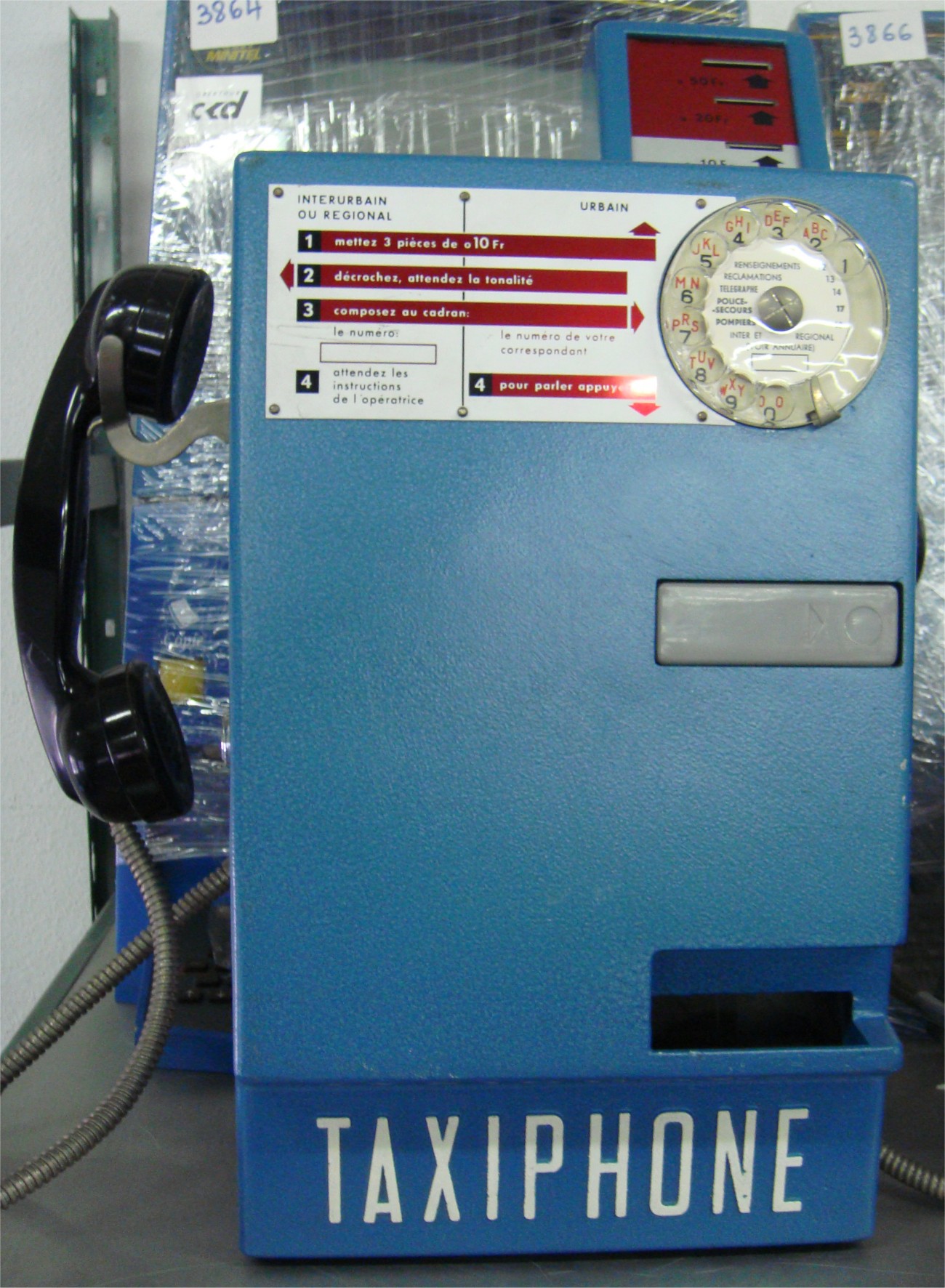
| Name | Type 400 Urbain |
| Date | 1957 |
| Manufacturer | Compagnie le Taxiphone for PTT |


Development of the Type 400 Urbain
| Following the introduction of periodic pulse-based charging in 1960—where calls were billed at fixed monetary values but variable time intervals—the first automatic interurban Taxiphones were developed. These systems enabled long-distance calls from public payphones, with coin collection controlled remotely by the exchange. The charging signal was transmitted via the telephone line as a 50 Hz frequency modulated in common mode relative to earth. Although classified as prepayment devices, these Taxiphones allowed the user to obtain a dial tone immediately upon lifting the handset, without inserting money. The correct sequence required the user to pick up, dial straight away, and, once connected, insert coins within 4 to 5 seconds. Failure to do so resulted in the call being cut off. During this brief interval, the microphone was disabled, preventing conversation before payment. The Type 400, introduced around 1957, combined urban automatic and interurban manual functionality. Operating with 20F, 50F, and 100F coins, it was equipped with a circuit identical to the U43 subscriber sets and retained the operating principles of the modified Benjamin Type 2, albeit within a redesigned casing. Classified under PTT number 277-400, approximately 4,000 units were produced before it was superseded by the Type 700. The Type 500 Taxiphone was a development of the earlier Type 400, housed within the same external casing but distinguished by the absence of a dial. Classified under PTT nomenclature number 277-500, it functioned as a manual interurban payphone, operating on principles similar to the Saint-Cyr type. Instead of direct dialling, the user was connected to a PTT operator, who then established the long-distance call on their behalf. This system reflects an intermediate stage in the evolution of public telephony, bridging manual and automated network operation during a period of expanding interurban communication. In practical use, the Type 500 would have followed a structured sequence: the user lifted the handset, was connected to an operator, and provided the required destination details. Payment was then managed in coordination with the operator-controlled connection process. Its design retained the robust and familiar housing of the Type 400, ensuring continuity in installation and maintenance. Also referenced is the Type 600, another Taxiphone model listed within the PTT classification system. However, little verified information survives regarding this variant, and no confirmed photographs or detailed technical descriptions are currently available, suggesting it was either produced in limited numbers or remained an obscure transitional model. |
| More info- https://www.publiphonie.fr/ |
Leave a Reply