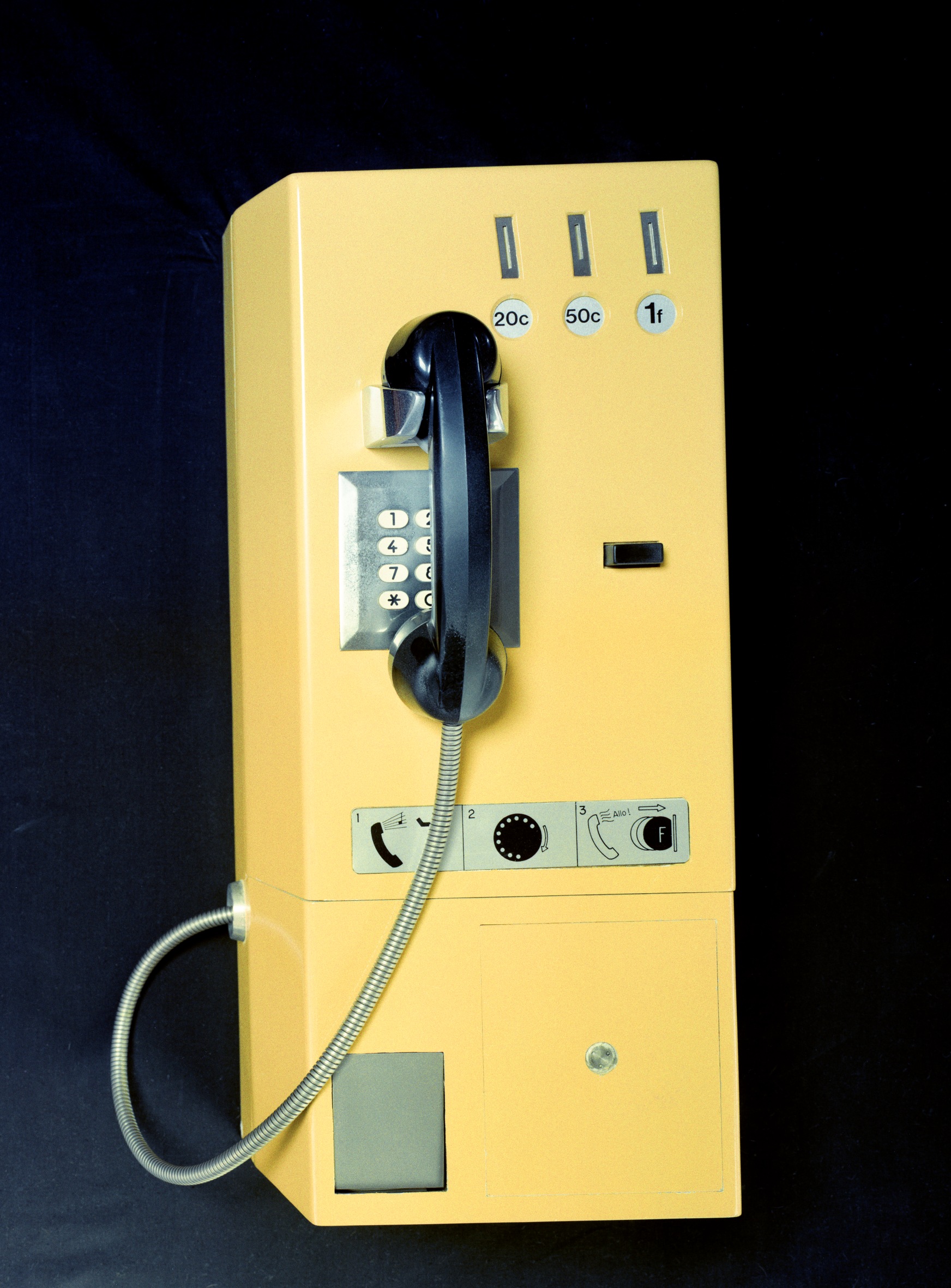
| Name | Briend Publiphone |
| Date | 1970 |
| Manufacturer | PTT |


Development of the Briend Publiphone
| The development of the Briend Publiphone must be understood within a brief but pivotal transition period in French telecommunications. In 1970, the long-standing concession granted to the Compagnie le Taxiphone (later SAFAA) was terminated, and the French PTT administration temporarily resumed full control over the design, manufacture, and operation of public telephones. During this short window, the PTT introduced a new generation of “publiphones,” marking a decisive technological break from earlier, mechanically driven taxiphones. The Type Briend, introduced in 1971, represents the culmination of this effort, particularly for interurban (long-distance) applications. Developed under the technical direction of the CNET and named after Jean Briend, a senior PTT engineer and specialist in taxation systems, the device embodied a shift toward electronic control. While it retained familiar features such as a triple coin selector (accepting 20 centimes, ½ franc, and 1 franc coins), its core innovation lay in its fully electronic accounting system. Mechanical “clockwork” tax comparators used in earlier models like the Type 700 were replaced by a semiconductor-based calculator using CMOS integrated circuits (4000 series), significantly improving reliability and reducing power consumption. Functionally, the Briend Publiphone followed established French user protocols: the caller dialled first and then inserted coins within a short time window once the connection was made, with the microphone muted until payment was registered. Revenue signals were transmitted automatically from the exchange using either 50 Hz modulation or 12 kHz signalling. Despite its technical sophistication, the Briend was produced in small quantities using semi-artisanal methods, with individually fitted components rather than interchangeable parts. This limited scalability, combined with increasing vandalism in unsupervised urban installations, contributed to its relatively short service life. By the late 1970s, these machines were withdrawn, making the Briend Publiphone a rare and important transitional artifact between mechanical taxiphones and later industrialised electronic payphones. |
| More info- https://www.publiphonie.fr/ |
Leave a Reply