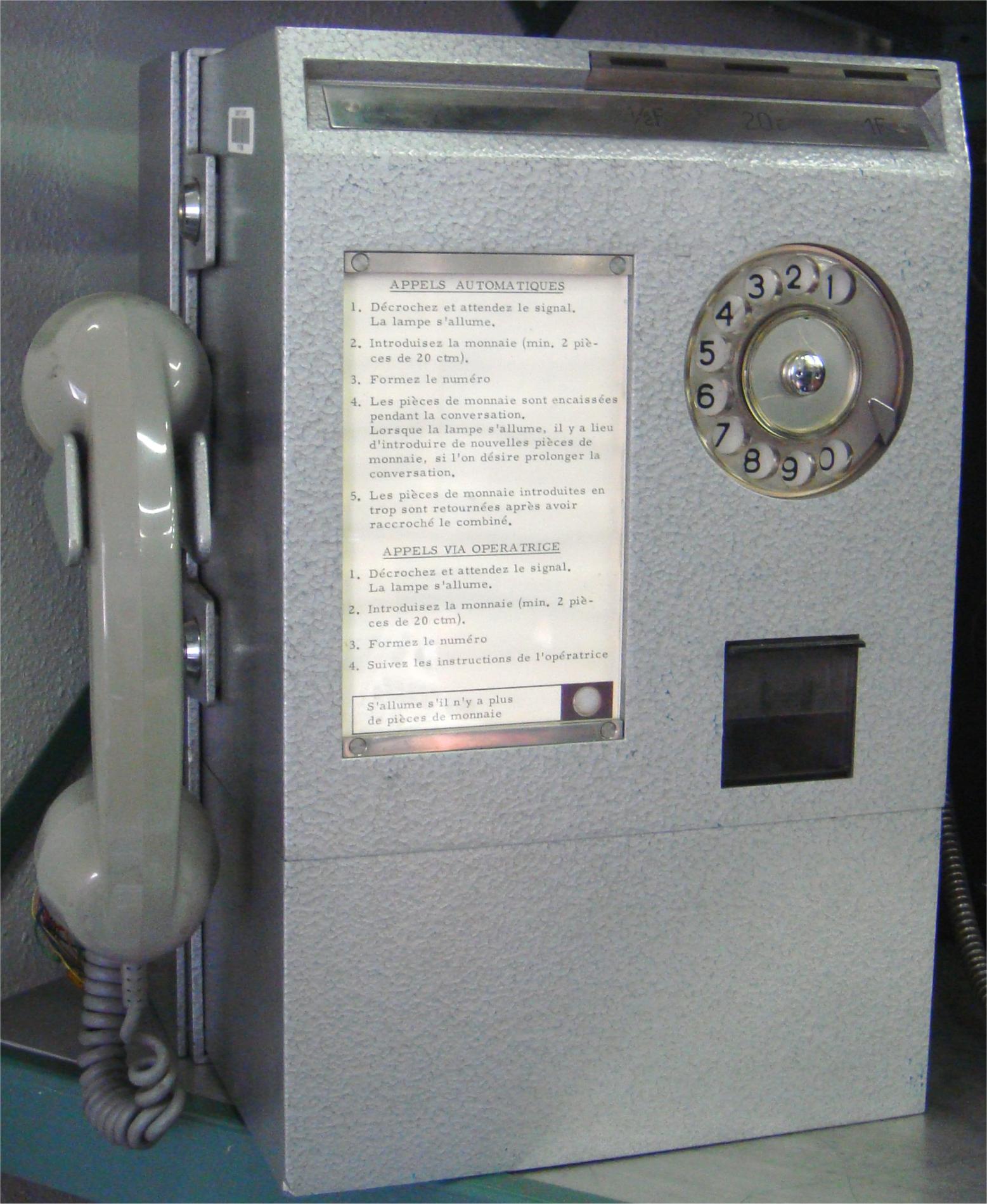
| Name | Type Bell |
| Date | 1965 |
| Manufacturer | PTT |


Development of the Type Bell
| The Type Bell interurbain (1965) represents a transitional European payphone design, combining established coin-control principles with increasing standardisation across national networks. Manufactured by Bell Telephone Manufacturing Company, it reflects the broader influence of ITT-associated technologies across continental Europe. Designed as an automatic, multi-coin payphone, it accepted three denominations—20 centimes Lagriffoul, ½ franc, and 1 franc Semeuse (Roty)—via separate selectors. This multi-coin capability made it suitable for interurban (long-distance) calls, where flexible payment and higher tariffs were required. The telephone circuitry was similar to the French S63 subscriber sets, ensuring compatibility with existing network infrastructure while maintaining familiar operational characteristics. Although primarily deployed in Belgium and Luxembourg, the Type Bell was also introduced into France from around 1970, following the end of the concession held by SAFAA (Compagnie le Taxiphone). In France, it appears to have been used more selectively, often in semi-private or high-traffic locations such as airports, cafés, and bars rather than standard street installations. Stylistically and technically, the Type Bell sits between earlier, more mechanical systems and later integrated designs. It retains clear mechanical logic and visible coin handling, while moving toward greater automation and network integration, marking an important step in the evolution of European public telephony. |
| More info- https://www.publiphonie.fr/ |
Leave a Reply