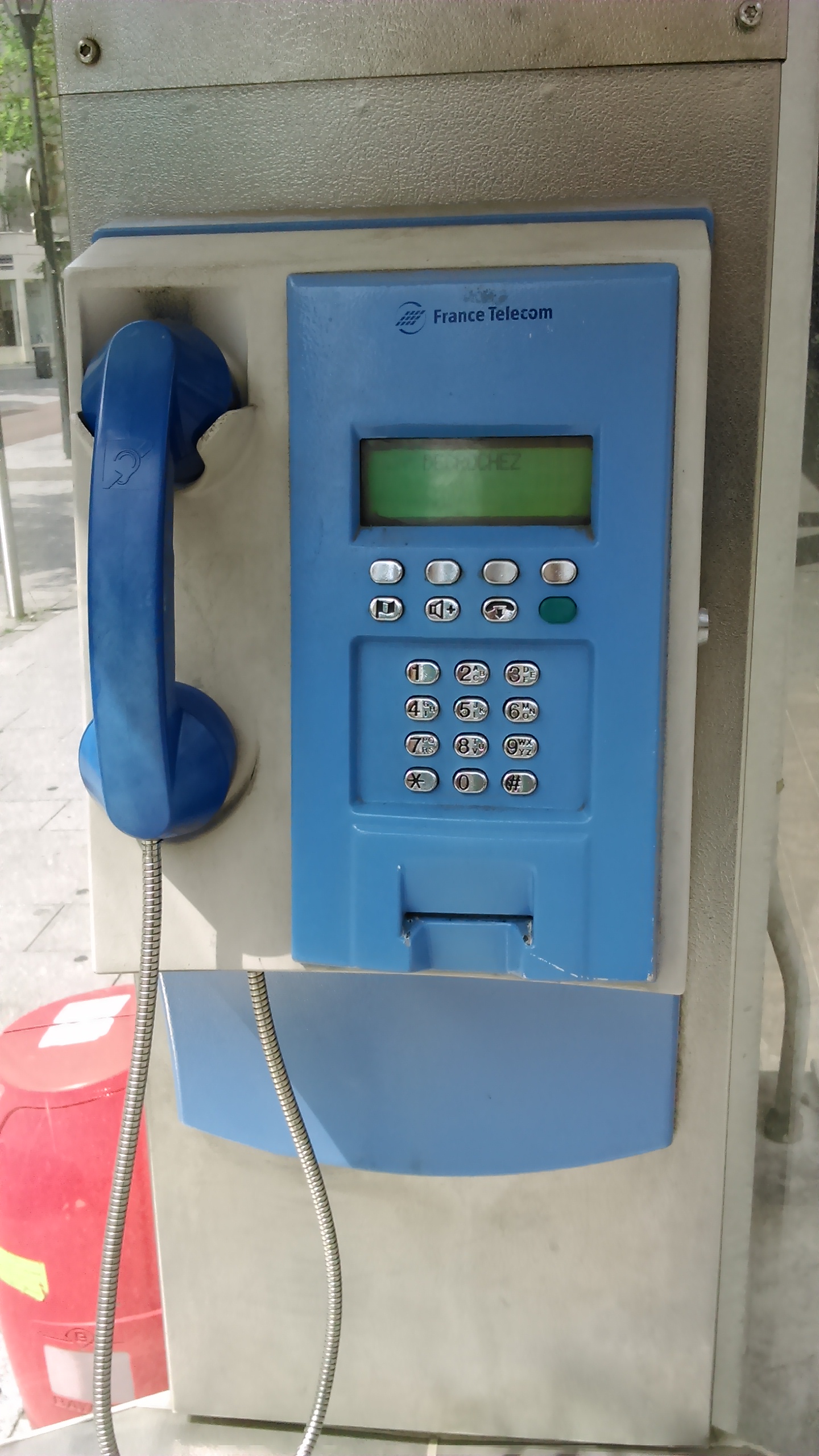
| Name | PF64 Schlumberger |
| Date | 1997. This generation represented the technological peak of French publiphone design, combining digital networking, multi-payment capability, and robust construction. |
| Manufacturer | Schlumberger for France Télécom Schlumberger led design, with Monétel and Landis & Gyr producing compatible models, differing mainly in casing, weight, and minor features. |
| Note | This payphone looks very similar to the Ascom eXANTO (link to model used in Namibia) |


Development of the PF64 Schlumberger
| The third generation of French prepaid card publiphones, introduced from 1997 (and in Paris from February 1998), marked the full transition to digital public telephony. Unlike earlier semi-analog systems, these machines operated entirely on the Numéris Publiphonie standard, based on RNIS (ISDN) technology. Each publiphone communicated directly with a second-generation connection module (MR2G), using a protocol closely aligned with standard subscriber ISDN services, significantly improving performance, reliability, and network integration. Development of this generation appears to have been led primarily by Schlumberger, with Monétel and Landis & Gyr producing parallel models under the same technical framework. Two main categories were offered: standard models accepting Télécartes, France Télécom cards, and chip-based bank cards; and “mixed” models, which additionally supported magnetic stripe cards via a secondary reader mounted on the side of the unit. In total, six models were marketed, differing mainly in manufacturer and minor cosmetic details rather than core functionality. All third-generation publiphones shared a consistent set of features. These included backlit LCD displays, amplified listening, and a “Bis” redial function. User guidance was delivered via the display in six languages—French, English, German, Spanish, Italian, and Portuguese—reflecting an increasingly international user base. Structurally, the units were built with cast aluminium chassis, contributing to durability while reducing weight compared to earlier designs. Among the models produced, Schlumberger offered the PF64 (6.8 kg) and PF64 Mixte (7.1 kg). Monétel produced the FTA704 (7.4 kg) and the mixed FTA574 (7.7 kg). Landis & Gyr’s contribution included the PL3GeB (5.5 kg) and the mixed PL3GeM (5.8 kg), the lightest of the series. This generation represented the technological peak of French publiphone design, combining digital networking, multi-payment capability, and robust construction before the widespread decline of payphones in the mobile era. |
| More info- https://www.publiphonie.fr/ |
Leave a Reply