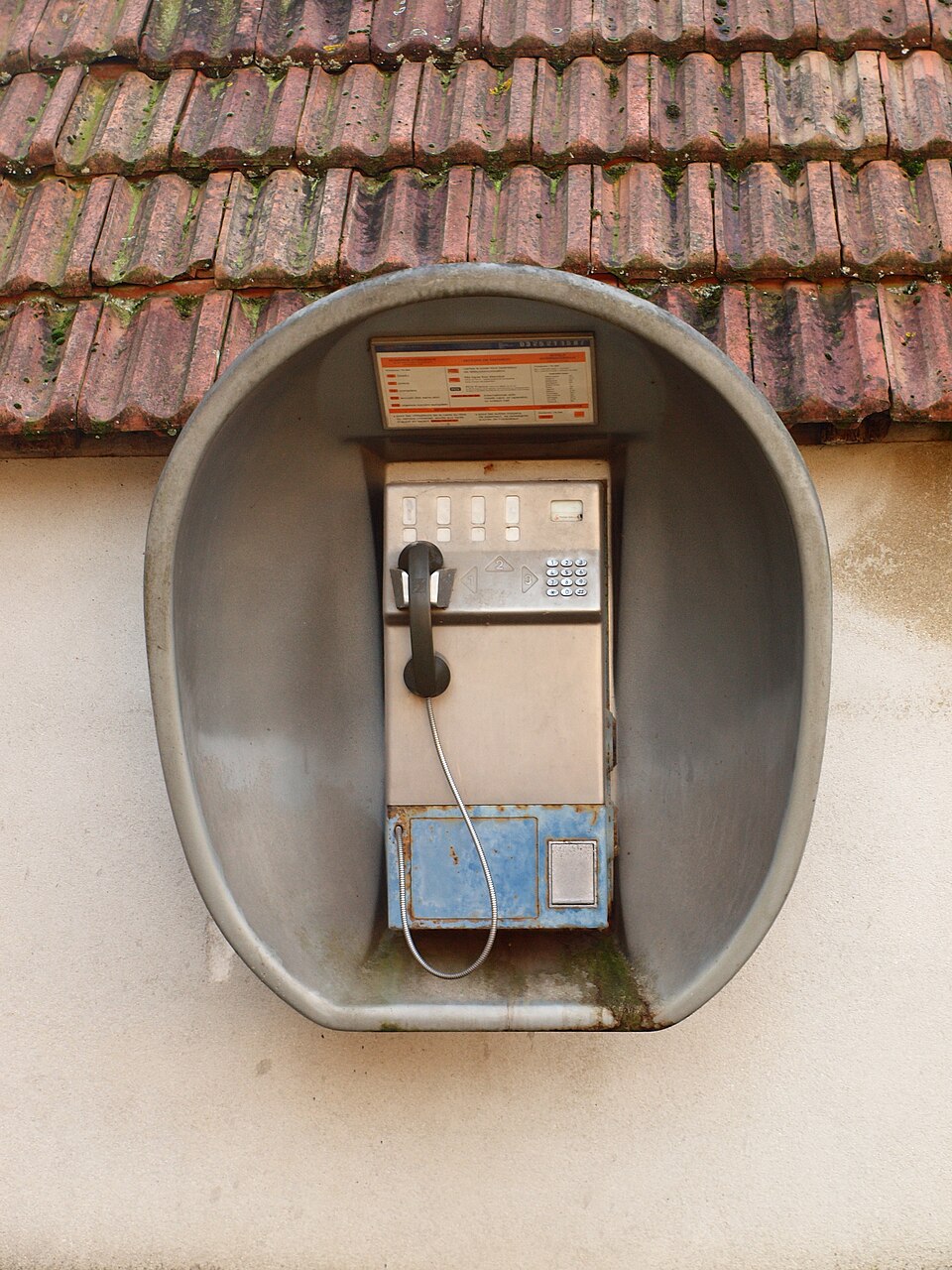
| Name | Type TE80 interurbain |
| Date | 1984-7 |
| Manufacturer | Landis & Gyr for PTT |


Development of the Type TE80 interurbain
| The Type TE80 interurbain represents the peak of French coin-operated publiphone design, combining extreme physical robustness with advanced electronic control. Developed from 1978 under a demanding CNET specification and manufactured primarily by Landis & Gyr (with production also by Crouzet), it entered service from 1984 and quickly gained a reputation as one of the most reliable and fraud-resistant payphones ever produced. The Type TE80 interurbain represents a significant evolution in French publiphone design, marking the transition from electromechanical interfaces to fully electronic, user-oriented systems. Developed by Landis & Gyr (and also produced by Crouzet), it was introduced in 1984 and remained in production until 1987, with approximately 45,000 units installed across France. Designed for long-distance and international calls, the TE80 accepted ½F, 1F, 2F, and 5F coins via four selectors. It retained compatibility with S63 reduced-current circuitry, ensuring integration with existing network infrastructure while improving efficiency. One of its most notable innovations was the inclusion of a liquid crystal display (LCD)—a first in French payphones—showing the remaining credit in francs. This represented a major shift toward transparent, real-time user feedback, replacing earlier reliance on tones or lights. Internally, the TE80 followed the architecture of the T900, using two large plug-in circuit boards (logic and analog), simplifying maintenance. The system could be configured for 50 Hz or 12 kHz tariff signals via a simple internal switch. Weighing approximately 57 kg, the TE80 featured a heavily reinforced structure in stainless and forged steel, designed to withstand intense vandalism and theft attempts. Its internal architecture was based on a microprocessor-controlled system—a major leap forward—using the RCA COSMAC 1802, with operational software stored in EPROM memory. This allowed the phone to be reprogrammed over time, adapting to changes in numbering plans, fixing bugs, and countering new fraud techniques. |
| More info- https://www.publiphonie.fr/ |
Leave a Reply