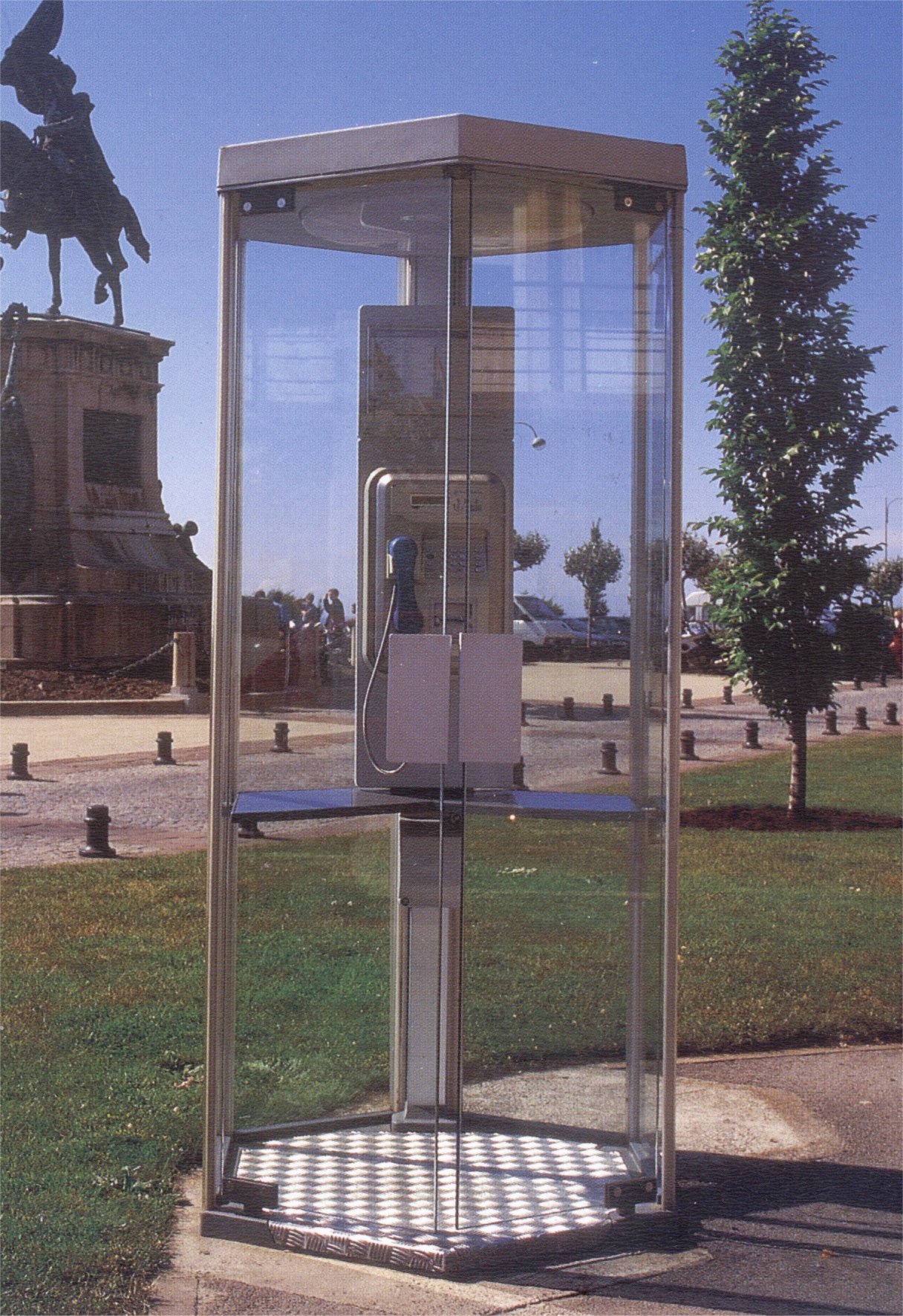
| Name | Cabine type 601 HEXAGON The 601 was the original Hexagon shaped model, with the chequerplate floor. |
| Date | 1990s |
| Manufacturer | France Télécom |


Development of the Cabine type 601 HEXAGON
| The French Booth 601 was one of the most recognisable and architecturally refined public telephone kiosks introduced during the major expansion of France’s publiphone network in the late twentieth century. Designed as a robust yet visually elegant structure, the booth reflected a distinctly French approach to public infrastructure, where even utilitarian street equipment was expected to contribute positively to the urban landscape. Its geometric hexagonal form gave the kiosk a sculptural quality that distinguished it from the more box-like telephone booths used elsewhere in Europe and North America. The booth was constructed using thick 8 mm Sécurit safety glass combined with a carefully engineered metal framework. This extensive glazing created an unusually transparent and lightweight appearance despite the substantial mass of the structure. The single booth weighed approximately 205 kilograms, while the larger double and triple versions weighed 388 kg and 562 kg respectively. These considerable weights reflected the heavy-duty construction required to withstand continuous public use, vandalism, and harsh weather exposure in dense urban environments. One of the defining features of the Booth 601 was its double-leaf glass doors. These doors improved accessibility and circulation while contributing to the booth’s symmetrical architectural appearance. The transparent walls also improved passive surveillance and safety, an increasingly important concern for public telephone installations during the 1970s and 1980s. The kiosk’s angular geometry and extensive use of glass aligned closely with broader French modernist design trends of the era, which favoured openness, lightness, and visual integration into civic spaces. France Télécom produced the Booth 601 in single, double, and triple configurations to accommodate varying levels of pedestrian traffic. These larger grouped arrangements became common in railway stations, commercial centres, and major public squares. More than a simple enclosure for a telephone, the Booth 601 functioned as a carefully designed piece of urban furniture, embodying the French belief that public amenities should combine practicality, durability, and architectural sophistication. |
033 France, Aluminium telephone box, Decorative Street Furniture, Design Icon, Free Standing, Painted or Stainless Steel, PTT / France Telecom, Telephone Box

Leave a Reply