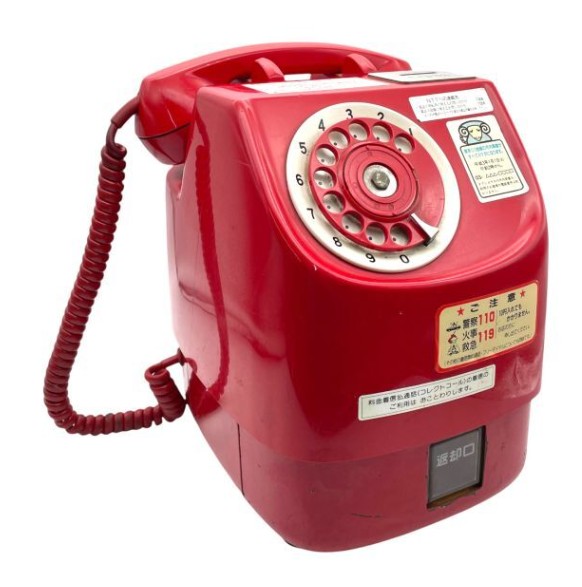
| Name | New Type “Red Phone” |
| Date | 1971 |
| Manufacturer | Tamura Electric Works for NTT |


Development of the New Type “Red Phone”
| Introduced in November 1971, this newly redesigned Japanese “red phone” represented a significant refinement of the earlier large public telephones that had become familiar throughout postwar Japan. Smaller, lighter, and more practical than its predecessor, the new model was specifically developed to suit installation inside shops, restaurants, kiosks and other semi-supervised indoor locations where space was limited. Its reduced size reflected the changing role of public telephony during Japan’s period of rapid economic growth, when convenient local access to telephones became increasingly important in everyday urban life. One of the most noticeable design changes was the lowering of the receiver hook by approximately five centimetres. This seemingly minor adjustment greatly improved usability and allowed the phone to fit more comfortably onto counters and narrow shelving. The redesigned mechanism also improved maintenance and reliability. Coins inserted incorrectly, or foreign objects deliberately placed into the machine, could often be removed simply by pressing the hook button, reducing service interruptions and the need for technician visits. Although primarily intended for ordinary local calls, the telephone also provided controlled access to important special service numbers. By informing the shop owner, users could place calls to emergency and operator-assisted services including police (110), fire and ambulance (119), directory assistance (104), telegram services (105), and long-distance operator assistance (100). |
Leave a Reply