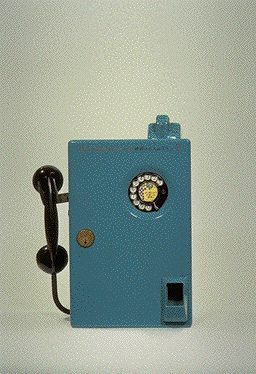
| Name | 1900 First Automatic Telephones 1947 Cash operated Public Phones at Shimbashi Station 1953 First Blue- Coin-Operated Public Telephone 1953 Red- First Red Phone |
| Date | 1900-1953 |
| Manufacturer | Various for NTT |

Above image- 1900 First Automatic Telephones (image NTT)
In September 1900, during the Meiji period, Japan’s public telephones moved beyond telegraph branch offices and post offices into busy city streets. The first were installed at Ueno and Shinbashi railway stations, followed a month later by the first outdoor public telephone box near Kyobashi. These early phones were called Jido Denwa, a Japanese rendering of “Automatic Telephone,” then seen on American street telephones. Their arrival changed the urban landscape and marked the beginning of public telephone culture in Japan. In 1901, male operators were abolished due to complaints about brusque service, making telephone operation a recognised occupation for young women.

Above image- 1947 Cash operated Public Phones at Shimbashi Station (image NTT)
After the Second World War, severe coin shortages disrupted the restoration of Japan’s public telephone network. In response, a new currency-type public telephone was introduced that could accept paper banknotes as well as coins. Existing coin-operated telephones were modified with a large slot designed for folded notes, accompanied by prominent instructions explaining the payment method. Because the machines could not automatically calculate or verify note payments, users were expected to honestly report the amount owed for their calls. The system therefore relied heavily on public trust and civic responsibility, reflecting the broader culture of cooperation that characterised Japan’s difficult postwar reconstruction period.

Above image- 1953 First Blue- Coin-Operated Public Telephone (image NTT)
In 1952, the circulation of 10-yen coins helped restore standard coin-operated service. The following year saw the introduction of the No. 4 automatic public box telephone, the first of Japan’s famous “blue phones.” Larger and redesigned blue phone models followed in 1968 and 1973.
Many postwar Japanese public telephones for the Nippon Telegraph and Telephone public network were manufactured by companies such as Anritsu, Tamura Corporation, Iwatsu Electric, and Oki Electric Industry.
My suspicion is that the early “blue phone” series was produced under contract for NTT by one of these firms, most likely Tamura or Anritsu, but I cannot verify that conclusively from available sources.

Above image- 1953 Red- First Red Phone (image NTT)
The destruction of telephone infrastructure during the Second World War created a severe shortage of telephones across Japan. To help restore communication services, simplified storefront public telephones were introduced. Two important types were the “simplified phone” and the “consignment phone,” both generally using the standard No. 4 automatic desktop telephone set. These phones were often installed in shops and small businesses, making telephone access more widely available to the public during the reconstruction years. In October 1953, the consignment public telephone was repainted in a striking red colour, marking the beginning of Japan’s famous “red phone,” which soon became a familiar feature of the nation’s streetscape.
Leave a Reply