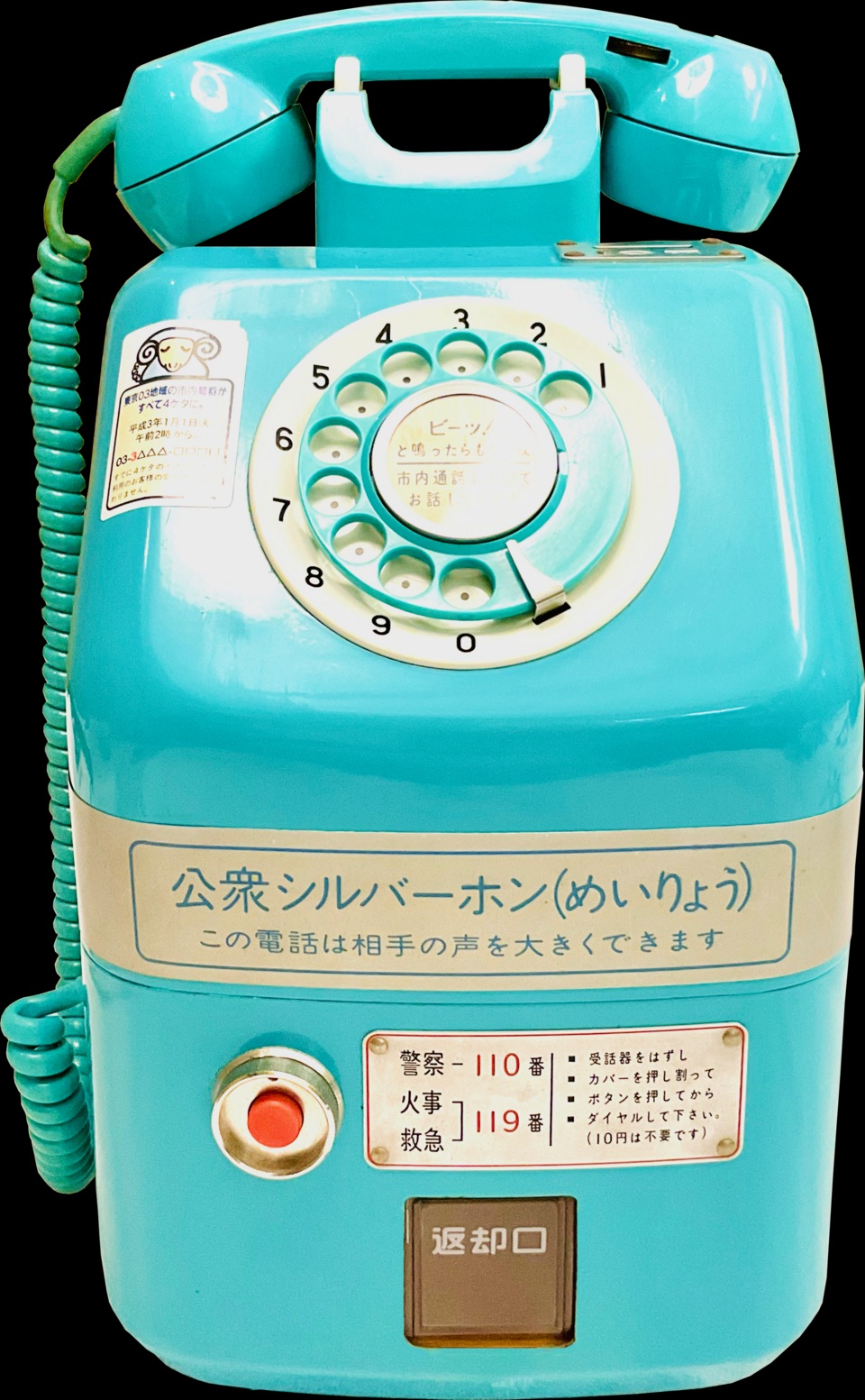
| Name | Green Phone and “Silver Phone” (シルバーホン) when shown with a silver band around it |
| Date | 1973 |
| Manufacturer | Tamura Electric Works for NTT |


Development of the Green Phone
| This distinctive turquoise Japanese public telephone is a classic example of the early postwar generation of NTT (formerly Nippon Telegraph and Telephone Public Corporation) payphones that became widespread across Japan during the 1950s and 1960s. Instantly recognizable by its rounded form, rotary dial, and vivid colour, the telephone reflects the uniquely Japanese approach to industrial design: compact, practical, friendly, and highly durable. The telephone shown is a “Silver Phone” (シルバーホン), a special type of public telephone developed for elderly users and people with hearing difficulties. The large Japanese label on the front reads “Public Silver Phone,” noting that the handset amplifies the caller’s voice. These accessibility-oriented telephones were installed in hospitals, welfare facilities, railway stations, and public buildings to make communication easier for ageing users in an increasingly urbanized society. Unlike many Western payphones of the period, Japanese public telephones often retained a softer, domestic appearance. Rather than looking harsh or industrial, they resembled household telephones enlarged into public form. This design philosophy reflected Japan’s broader postwar consumer culture, where electronics were expected to feel approachable and humane. The rotary dial mechanism used pulse dialing and was engineered to extremely high standards of reliability. Japanese payphones of this era were renowned for precision manufacturing and resistance to vandalism. Emergency call buttons allowed direct access to police and fire services, while the coin-return compartment and robust metal fittings reveal the machine’s public utility role. The bright blue-green colour also became iconic in Japan. Later generations of “midori denwa” (“green phones”) would continue this tradition of brightly coloured public telephones that stood out clearly within busy streets and railway stations. Today these telephones are highly collectible and admired not only as communications devices, but also as masterpieces of mid-century Japanese industrial and urban design. Below- various Tamura Electric Works payphones |

Leave a Reply