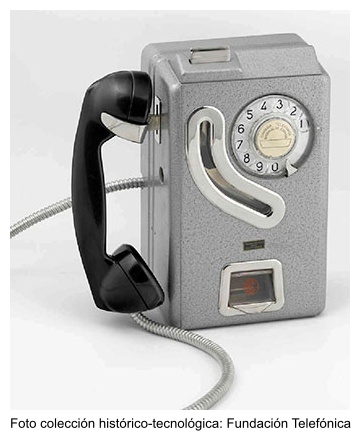
| Name | Teléfono público 5536 SP-1960-5536A FICHAS (TOKENS) and 5536M FICHAS Y PESETAS (TOKENS AND COINS) |
| Date | 1960 |
| Manufacturer | Telefónica Compañía Telefónica Nacional de España (CTNE) (“National Telephone Company of Spain”) Founded in 1924 during the rule of Primo de Rivera. |


Development of the Teléfono público 5536
| The Spanish Teléfono público of the 1960s belonged to a generation of rugged electromechanical public telephones installed throughout Spain during the expansion of the national telephone network under Telefónica. Most were operated by the state-dominated Compañía Telefónica Nacional de España (CTNE), commonly known simply as Telefónica. Spain introduced payphones and booths somewhat later than England and the USA, installing these widely in the 1960s during Franco’s rule. Designed and manufactured locally, these early public telephones were usually coin-operated wall or booth-mounted units manufactured by Spanish companies such as CITESA. Designed for heavy public use, they featured thick steel housings, rotary dials, mechanical coin validators and robust handsets connected by reinforced metal cords. Their simple industrial appearance reflected the practical priorities of post-war Spain, where reliability and vandal resistance were essential. The telephones were installed in railway stations, cafés, post offices, airports, city streets and the famous glass-and-aluminium “cabinas telefónicas” that became part of the Spanish urban landscape. Calls were generally paid for with coins, and many units used mechanical timing and metering systems that produced distinctive clicking sounds during a call. |

Above- Jose Luis Lopez Vazquez in the film La cabina Link- Payphones in Cinema (for more info)


Leave a Reply