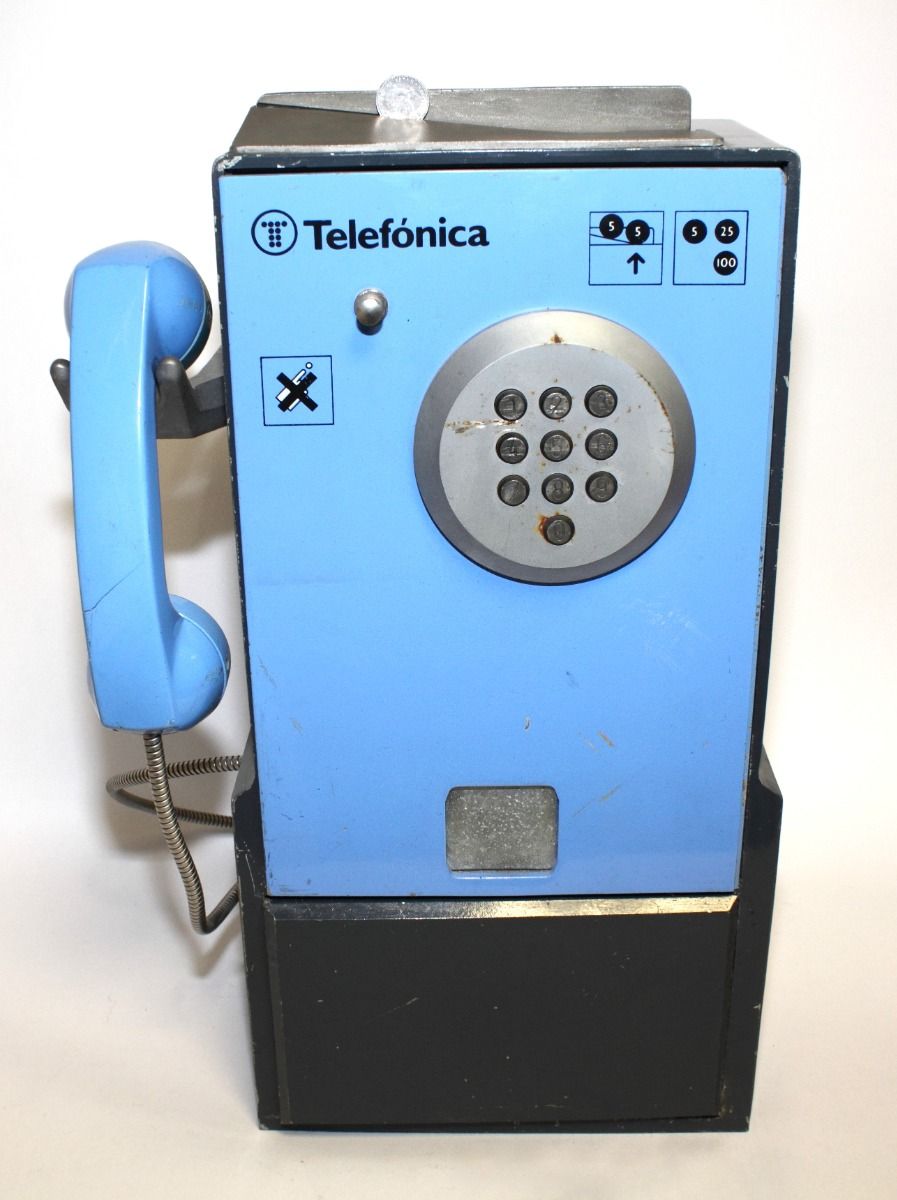
| Name | Teléfono público TPROM-01 AMPER TEPROM |
| Date | 1989, The beginning of the signature Blue Telefónica colour |
| Manufacturer | Amper-Elasa in Zaragoza for Telefónica Design based on the GNT SP-1970-Teléfono público GNT |

Development of the Teléfono público TPROM
| The Amper TEPROM was one of the most distinctive Spanish public telephones of the late 1980s and early 1990s. Manufactured in Spain by Amper for Telefónica, it represented a transition from earlier rotary and electromechanical payphones into a more modern electronic generation designed for heavy urban public use. The model shown here is the original 1989 TEPROM (“Teléfono Público Monedero”), a rugged coin-operated unit intended for installation inside Spain’s aluminium-and-glass street booths and transport terminals. It was specifically engineered to survive vandalism, weather exposure and extremely high daily usage. The thick steel body, recessed components and protected keypad all reflect this philosophy. One of the most unusual design features is the coin-loading rail at the top of the phone. Rather than a traditional front coin slot, users placed 5, 25 or 100 peseta coins onto the angled metal guide, allowing the machine to mechanically verify and process them. Coins dropped into a secure lower iron collection box accessed through a locked trapdoor used by Telefónica collection staff. The circular keypad assembly became a recognisable visual trademark of the TEPROM series. Its industrial appearance was very different from the sleeker Western European payphones of the same era. The brightly coloured handsets — often blue, green or grey — gave the units a more modern and approachable look inside Spain’s otherwise utilitarian phone booths. The TEPROM also reflected broader changes occurring in Spain during the late Franco and post-Franco telecommunications expansion. By the 1980s, Telefónica was modernising the national public telephone network rapidly, replacing older rotary coin-box designs with electronic systems capable of better tariff control, simplified maintenance and improved anti-fraud measures. These phones became part of everyday Spanish street life. They appeared in railway stations, airports, city pavements, cafés and the famous “cabinas telefónicas” found throughout Madrid, Barcelona and smaller provincial towns. The photograph of French actor Jean-Paul Belmondo using one at Barajas Airport in 1986 captures how iconic these telephones had already become. Technically, the TEPROM sat between fully electromechanical public telephones and the later smart-card/digital public telephones introduced during the 1990s. Amper would later become involved in more advanced electronic public telephony systems, helping Spain emerge as an exporter of public telephone technology to parts of Latin America and elsewhere. The model is now increasingly collectible because relatively few survived. Many were scrapped during Spain’s rapid payphone modernisation in the 1990s and 2000s. Collectors value them for their unmistakably Spanish industrial design, heavy-duty engineering and association with the final great era of coin-operated public telephony in Spain. |


Above- Teléfono público TPROM (coin operated)

Leave a Reply