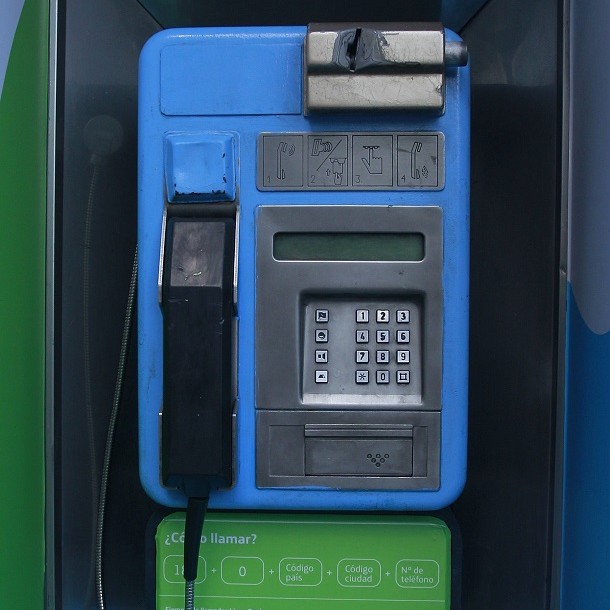
| Name | Teléfono público MODULARES |
| Date | 2000 The iconic Spanish blue payphone |
| Manufacturer | Infopyme Comunicaciones for use across across Spain and much of Latin America, especially under operators such as Telefónica, Movistar, Telefónica del Perú and Cuban telecom authorities. Also used in Mexico. |

Development of the Teléfono MODULARES


The TM-01 / TM series (“Teléfonos Modulares”) was one of the most recognisable Spanish-language public telephone platforms of the 1990s and early 2000s. It was produced by the Spanish telecommunications manufacturer Infopyme Comunicaciones and became widespread across Spain and much of Latin America, especially under operators such as Telefónica, Movistar, Telefónica del Perú and Cuban telecom authorities.
Your photos show several important variations of the system:
- Early peseta coin-only versions
- Hybrid coin + phonecard models
- Later euro-era versions
- Units adapted for prepaid mobile recharge
- Export variants for Peru, Cuba, Argentina and elsewhere
The “TM” name literally means Modular Telephones, which reflected the design philosophy. These payphones were built from interchangeable modules:
- coin validator
- card reader
- LCD display
- keypad assembly
- communications board
- money box
- handset module
This modular approach made them cheap to maintain and easy to adapt for different countries and currencies.
Visually, the TM series had a very distinct appearance:
- thick blue or grey vandal-resistant casing
- stainless steel faceplate
- small monochrome LCD
- membrane or metal keypad
- large industrial coin slot assembly
- heavy handset with reinforced cord
The design was intentionally rugged rather than elegant. Many were installed in glass-and-aluminium Spanish street booths, railway stations, airports and shopping centres. During the late 1990s they became almost symbolic of urban Spain and Latin America.
One interesting aspect of the TM system was its transition into the mobile-phone era. Infopyme later adapted the platform to sell prepaid cellular top-ups directly from the payphone itself. Some of your images show this evolution, with Movistar recharge advertising and modified keypads.
The platform appears to have evolved into later Infopyme systems such as the “Condor” GSM payphone family, which added remote monitoring, electronic management and mobile recharge functions.
Infopyme itself remains active today and still describes itself as a major manufacturer of public telephones and spare parts, with over 200,000 installations worldwide. The company supplied systems across:
- Spain
- Peru
- Chile
- Ecuador
- Cuba
- Mexico
- Australia
- New Zealand
- the Philippines
- South Africa
- Russia
- Turkey
among others.
Historically, the TM series sits at an important transition point between:
- older electromechanical coin telephones of the 1960s–1980s, and
- later internet-connected, smartcard and GSM-based public communication terminals.
They were among the last truly mass-deployed “classic” public payphones in the Spanish-speaking world before mobile phones caused the rapid collapse of public telephony after about 2005.
Below- Teléfono MODULARES in use in Cuba (in traditional Spanish paint colour)

Below- in use in Argentina


Below- in use in Chile


Above- these cast iron and glass booths were quite common in Chile
Below- in use in Croatia


Leave a Reply