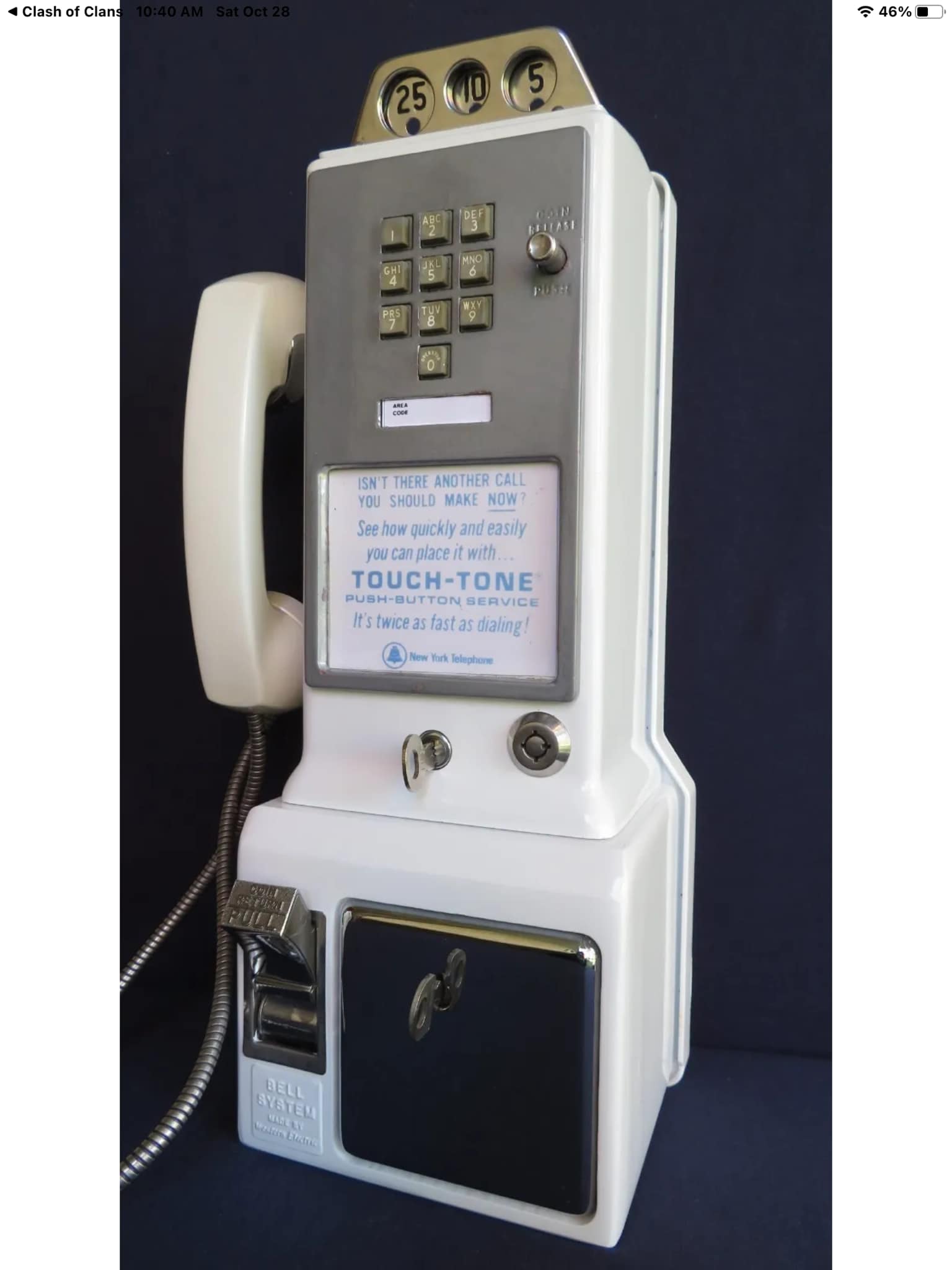
| Name | WE 1234G Payphone |
| Date | mid-1960s (e.g., around 1964) |
| Manufacturer | Western Electric |


Development of the 1234G Payphone
| Above- This is one of the rarest payphones. The Western Electric 1234G in white. These were issued to New York Telephone for use at the World Fair in Queens, New York (New York City). Pictures from eBay. Western Electric 1234G payphone — one of the more obscure classic Bell System payphone models: What the 1234G Is Western Electric 1234G was a three-slot coin-operated payphone made by Western Electric for the Bell System in the U.S. It’s notable for being a Touch-Tone version of the classic three-slot payphones — most of which used rotary dialing — and retains the traditional three separate slots for nickel, dime and quarter coins. These three-slot payphones were widely used from the mid-20th century through the 1960s and into the early 1970s before single-slot payphones became the norm. Features of the 1234G 3 Slot Coin Box: Separate slots for 5¢, 10¢ and 25¢ coins, each triggering a different signal as coins drop (one ding for nickel, two for dime, louder gong for quarter). Push-Button Touch-Tone Dial: Unlike many earlier payphones that used a rotary dial, the 1234G used a ten-button push-button keypad, reflecting the touch-tone technology introduced in the 1960s. Bell System Equipment: As with other Western Electric payphones, it was designed to work with Bell System central office equipment. The internal wiring for the 1234G was denser than earlier models due to the added circuitry for touch-tone and coin control. Polarity Sensitive: Early touch-tone payphones (including this one) were sensitive to the telephone line’s tip and ring polarity — if the keypad didn’t generate tones, reversing the line wiring often fixed it. Era and Rarity Although exact production years for the 1234G aren’t widely documented, surviving examples (e.g., listings and collector photos) often date from the mid-1960s (e.g., around 1964) onward. These touch-tone three-slot payphones are rarer than the standard rotary models (like the ubiquitous 233G) because touch-tone was only just beginning to be rolled out in the 1960s, and payphone demand for push-button service was comparatively limited at first. |
Leave a Reply