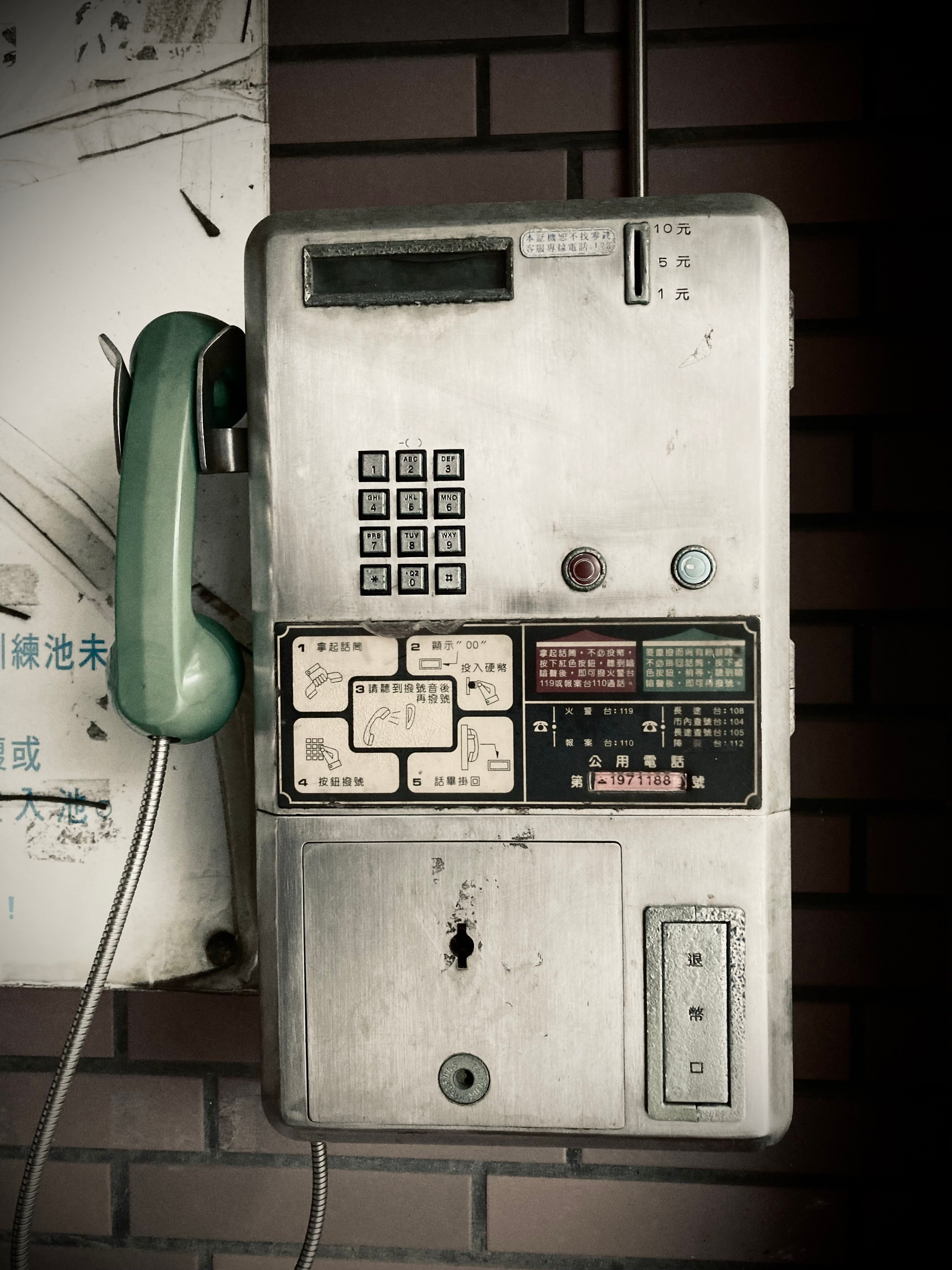
| Name | TT-630 |
| Date | 1987 to present Coin return similar to the US Fortress payphone |
| Manufacturer | Taiwan Telecommunication Industry (TTI) Directorate General of Telecommunications (DGT |


Development of the Taiwan Rotary Coin Payphone TT-630
The TT-630 was one of Taiwan’s most successful electronic coin-operated public telephones, introduced in 1987 as part of the Directorate General of Telecommunications’ (DGT) modernisation of the national payphone network. Designed for both local and long-distance calling, the TT-630 accepted NT$1, NT$5 and NT$10 coins through a single coin slot and represented a major technological advance over earlier rotary and first-generation keypad telephones. The National Science and Technology Museum records the model as first appearing in 1987, with surviving examples manufactured as late as 1991, demonstrating that production continued for several years.
Unlike earlier electromechanical payphones, the TT-630 employed a microprocessor-controlled electronic system with built-in self-diagnostics, DTMF push-button dialling, polarity-reversal charging, and an LCD display showing the value of deposited coins. The telephone stored up to four coins of mixed denominations, collected charges during the call, and allowed any remaining credit to be reused for another call. It also supported local, national and international direct-dial services, emergency calls and operator-assisted calls.
The rugged stainless-steel housing was designed to withstand heavy public use and vandalism. Large service doors provided easy access to the electronics and secure coin vault, while the armoured handset cord and durable ABS handset ensured long service life. Many units were installed in Taiwan’s distinctive red public telephone booths, although others were wall-mounted in railway stations, government buildings and shopping districts.
Although no definitive manufacturer has yet been identified, the TT-630 was almost certainly produced by a Taiwanese telecommunications manufacturer under contract to the DGT. The strongest candidate is Taiwan Telecommunication Industry Co. (TTIC), which manufactured a wide range of coin, magnetic-card and IC-card public telephones for Taiwan and export markets, and traced its origins to a long-standing joint venture with Japan’s Tamura Electric. This would explain the TT-630’s clear Japanese design influence, including its modular electronics, stainless-steel cabinet and keypad layout.


Leave a Reply