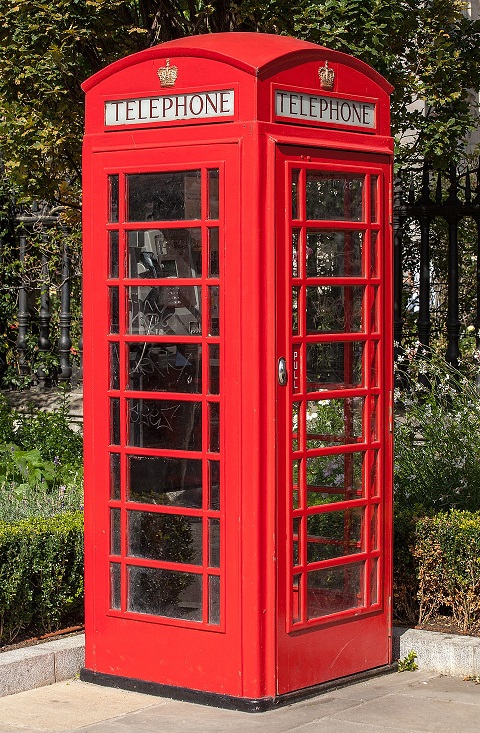
| Name | K6(II) Kiosk No. 6 Mk. II |
| Date | 1939 |
| Manufacturer | BPO |
| Usage | Public call box. |

Development of the BPO K6(II) Kiosk No. 6 Mk. II

Above- a short-lived attempt in the 70’s to convert the booths from red to Telecom yellow (as was done in Australia)
| Kiosk No. 6 Mk. II The MK 2 MacFarlane K6 kiosk refers to the Mark 2 variant of the iconic British K6 red telephone box, cast by Walter MacFarlane & Co. at the historic Saracen Foundry in Glasgow, Scotland. Introduced in 1939, it is an updated production model of the famous 1935 “Jubilee Kiosk”. Key Details & IdentificationThe Manufacturer: Walter MacFarlane & Co. was one of a handful of foundries commissioned by the General Post Office (GPO) to manufacture the K6. You can find their foundry name embossed on the lower rear exterior panel, between the cable entry holes.Mark 2 Updates: The K6 Mark 2 (introduced in 1939) maintained the beloved streamlined aesthetics of architect Sir Giles Gilbert Scott but featured slight updates to its sill frame, corner pillars, and glazing framework The British Telephone Kiosk No. 6 (K6) was manufactured from 1936 until around 1968. Introduced: 1936, to commemorate King George V’s Silver Jubilee (it’s sometimes called the Jubilee Kiosk). Designed by: Sir Giles Gilbert Scott, also the designer of the K2 kiosk. End of production: Although there is no exact “cut-off” year, large-scale manufacture ceased by the late 1960s, when the K8 kiosk began replacing both K6 and earlier types from 1968 onward. Production peak: Most units were installed in the 1940s–50s; over 60,000 K6 kiosks were eventually installed across the UK, making it the most common red telephone box. Many K6s survive today, often repurposed (e.g., as libraries, defibrillator stations, or mini-museums). |


Leave a Reply