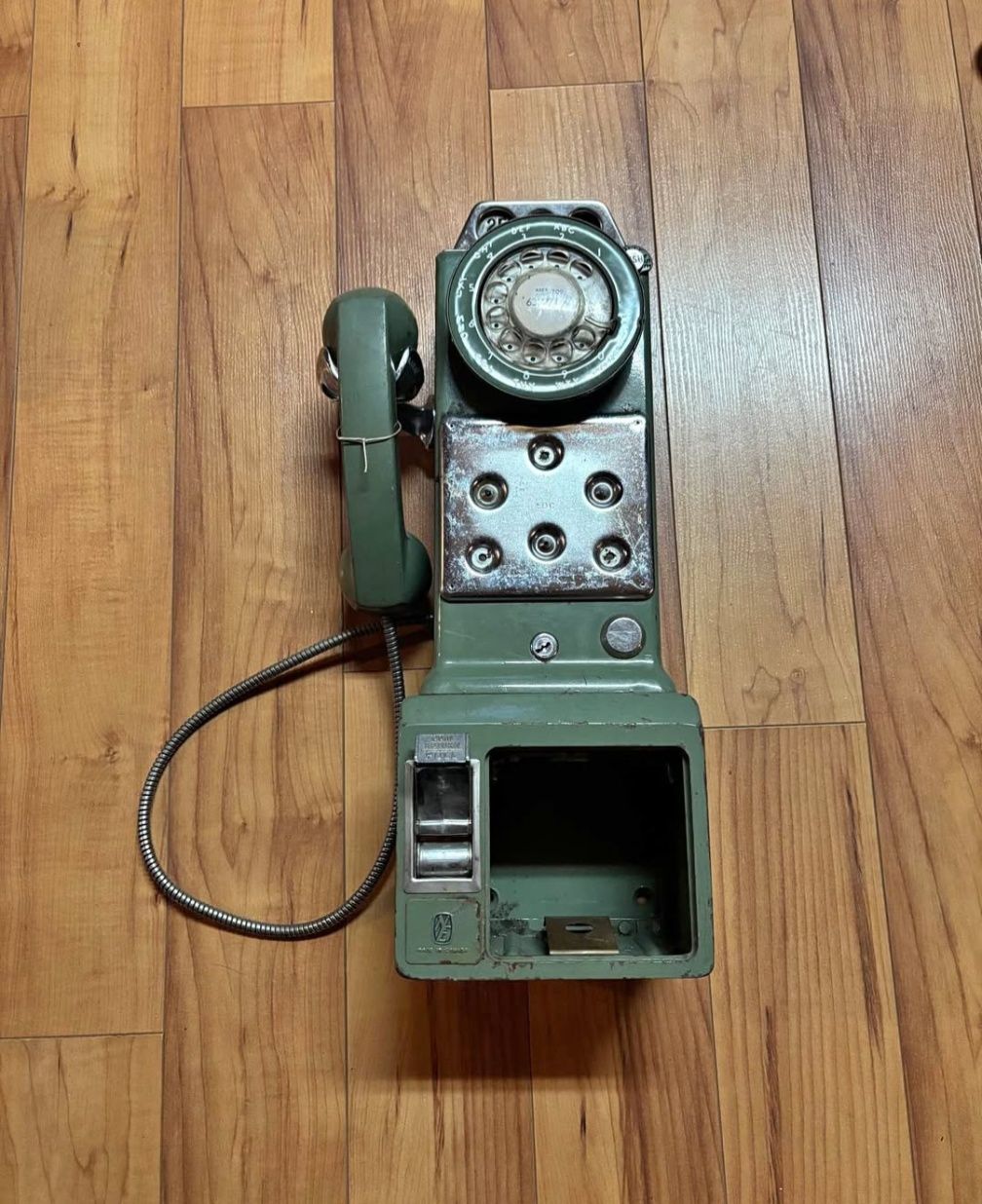
| Name | NORTHERN ELECTRIC QSD 3A |
| Date | Circa 1970 |
| Manufacturer | Northern Electric |


Development of the NORTHERN ELECTRIC QSD 3A
| With thanks to https://www.oldtelephoneroom.ca/ QSD (Quarter–Slot Dial) denotes a three-slot rotary-dial prepay payphone configured for central-office control. It accepts nickel, dime, and quarter coins, using an electro-mechanical coin relay and hopper for collect/return supervision. Common in mid-20th-century North American installations, QSD sets represent mature three-slot dial technology before Touch-Tone adoption. The Quarter-Slot Dial (QSD) was used in both Canada and the United States and was not uniquely Canadian. It appeared in selected North American installations but was never adopted as a universal Bell System standard. The mechanism integrated coin deposit and dial operation: a single quarter was inserted directly into a slot within the rotary dial assembly. When the user rotated the dial to its stop, the action simultaneously generated the rotary pulse train to signal the exchange and registered or released the coin for collection. In the United States, QSD units were found particularly in some independent telephone company installations and in locations where a single 25-cent coin covered the local tariff. They were less common within the mainstream Bell System once centralised coin-supervision systems—pre-pay and post-pay with relay control—became dominant. As multi-coin pricing structures (5¢, 10¢, and 25¢ combinations) became standard, the QSD’s single-denomination limitation reduced its practicality. In Canada, QSD installations were seen under Bell Canada and independent operators. Canadian tariff structures sometimes allowed the single-quarter design to remain practical longer, and Canadian manufacturers were comparatively receptive to integrated mechanisms. Overall, the QSD was a North American development suited to stable, single-coin tariff environments rather than variable, distance-based pricing systems. |
Leave a Reply