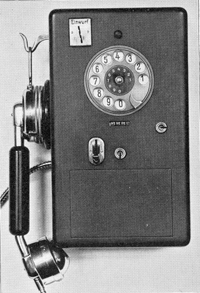
| Name | Münzfernsprecher 22 |
| Date | 1922 |
| Manufacturer | Deutsche Reichspost |

Development of the Münzfernsprecher 22
| The Münzfernsprecher 22 was a German coin-operated public telephone introduced under the Deutsche Reichspost during the early 20th century as part of a program to expand self-service telephony. It was a wall-mounted unit constructed largely of metal, incorporating a mechanical coin mechanism and internal switching components that controlled call connection and duration. The system relied on electromechanical processes, with users inserting coins to initiate and sustain calls. These telephones were installed in locations such as post offices, railway stations, and other publicly accessible buildings (and some very early kiosks), providing broader access to communication at a time when private telephones were still limited. Compared with contemporary systems in other countries, the Münzfernsprecher 22 was broadly similar in technological approach but not necessarily the most advanced. In the United States, early payphones developed by companies such as Western Electric often incorporated more refined automatic coin control and, in some cases, earlier integration with fully automatic exchanges. In the United Kingdom, the General Post Office deployed coin telephones that were closely tied to the rollout of standardised kiosks and increasingly automated networks. In Australia, systems under the Postmaster-General’s Department followed a similar trajectory but generally lagged slightly in automation. Overall, the Münzfernsprecher 22 reflects a transitional stage: robust and effective, but broadly comparable rather than leading in global technological development. Link- PDF manual |
| More info- https://oeffentlichetelefone.de/ |
Leave a Reply