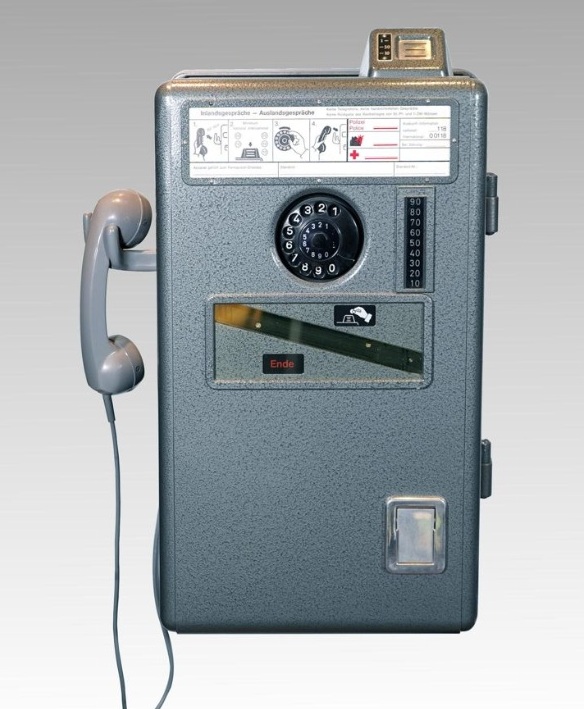
| Name | Münzfernsprecher 57 (MünzFw 57) With the wonderful sloped window where you could see your coins being munched up. |
| Date | 1957, Designed for mass deployment in booths, etc. |
| Manufacturer | Deutsche Bundespost |


Development of the Münzfernsprecher 57
| The Münzfernsprecher 57 was a German coin-operated public telephone introduced in the late 1950s under the Deutsche Bundespost as part of the post-war expansion and modernisation of public telephony. It represented a mature stage in electromechanical payphone design, building on earlier models such as the MF 50. The unit was typically housed in a robust wall-mounted metal cabinet, with a modular internal arrangement separating the telephone, coin mechanism, and secure cash box. Its coin system used advanced electromechanical validation, with channels and gauges to check coin size and weight before directing accepted coins into a locked collection container. A coin return mechanism allowed refunds if calls were not successfully connected. Technically, the MF 57 was fully relay-based, integrating coin control with the telephone exchange. Users inserted coins either before or during the call, with internal relays and exchange signalling regulating call connection, duration, and payment. A rotary dial with additional electrical contacts linked dialling to the coin control system. Installed in street kiosks, railway stations, and public buildings, the Münzfernsprecher 57 was widely deployed across West Germany. It marks the peak of mechanical payphone engineering before the transition to electronic and card-operated systems in later decades. On payphones such as the Münzfernsprecher 57 used by the Deutsche Bundespost, the sloped viewing window allowed users to see coins moving through the mechanism. This provided clear visual feedback, showing whether coins were accepted or returned, helping build trust and reduce disputes. The angled design followed the gravity-fed coin path and improved visibility by reducing glare. It also reflected a thoughtful approach to industrial design, making the internal process visible rather than hidden. The result was both functional and engaging, turning a technical operation into a small, observable event for the user. |
| More info- https://oeffentlichetelefone.de/ |
Leave a Reply