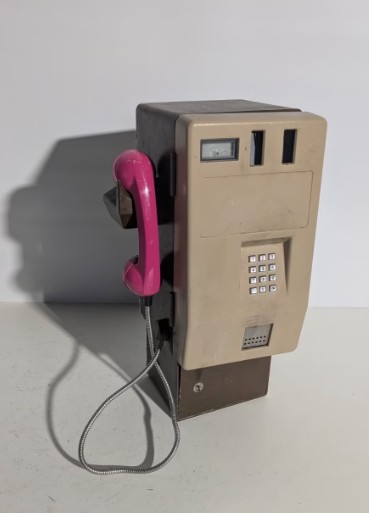
| Name | Münzfernsprecher Clubtelefone 1 |
| Date | Late 70s to mid 90s |
| Manufacturer | Deutsche Bundespost, produced by multiple approved manufacturers including Telefonbau und Normalzeit (TN) and Bosch Telecom |


Development of the Münzfernsprecher Clubtelefone 1
| The Münzfernsprecher Clubtelefon 1 was an early form of privately operated indoor payphone used in West Germany, emerging in the late 1970s and becoming widespread through the 1980s and early–mid 1990s. Developed during the final years of the Deutsche Bundespost and expanding after telecommunications liberalisation, it represented a clear alternative to state-run public street payphones. Typically installed in pubs, hotels, hostels, hospitals, and similar venues, the Clubtelefon 1 was usually owned or leased by the venue operator, allowing them to generate income from outgoing calls. This marked a shift toward decentralised, commercial telephony, where flexibility and revenue generation became key drivers rather than uniform public service provision. Technically, the unit connected to a standard analogue telephone line but relied on the German 16 kHz metering pulse system to calculate call charges. These pulses were converted into coin credit and deducted as the call progressed. The design was generally electromechanical or hybrid, bridging the gap between earlier relay-based Münzfernsprecher and later fully electronic systems. It accepted Deutsche Mark coins and incorporated a coin validator, secure cash box, and basic tariff controls, enabling some configuration of pricing and call restrictions. “Clubtelefon 1” was not a single standardised model but a type designation, produced by multiple approved manufacturers including Telefonbau und Normalzeit (TN) and Bosch Telecom. Its use declined in the late 1990s with the rise of digital payphones and mobile telephony. |
| More info- https://oeffentlichetelefone.de/ |
Leave a Reply