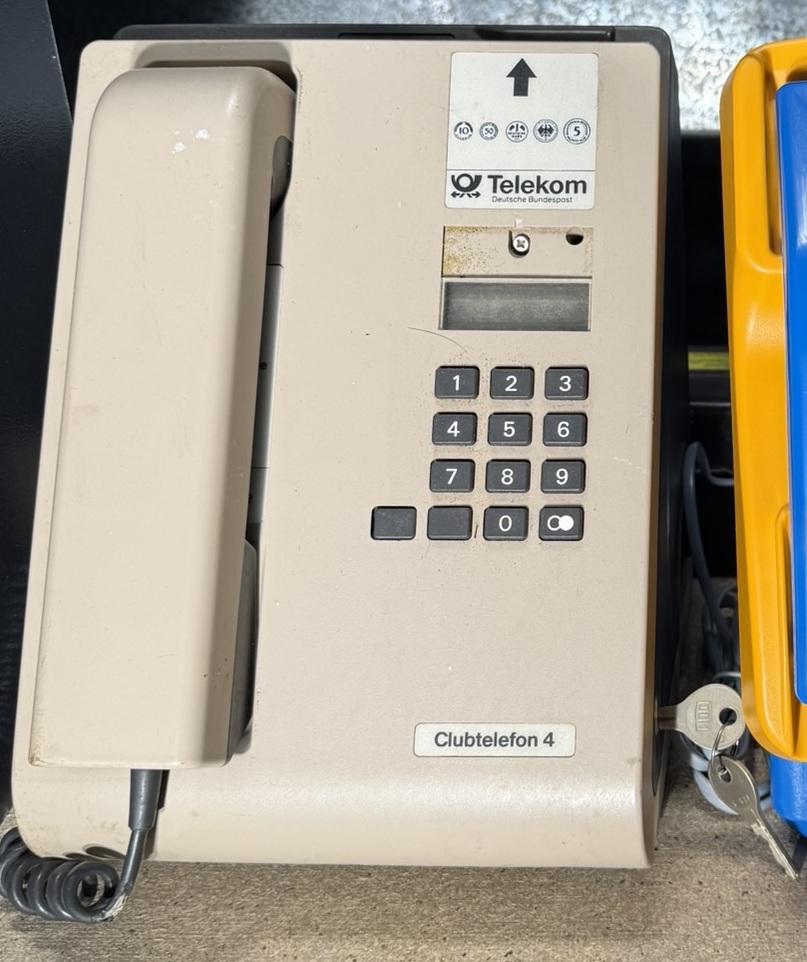
| Name | Münzfernsprecher Clubtelefone 4 |
| Date | 1990 (it could not be converted for Euro currency, leading to its withdrawal by the end of 2001) |
| Manufacturer | Deutsche Bundespost |

Development of the Münzfernsprecher Clubtelefone 4
| The Clubtelefon 4 (also designated TMünzFw77) was a second-generation indoor coin-operated telephone introduced in Germany around 1990, following the earlier Clubtelefon 1. Developed during the late Deutsche Bundespost Telekom era, it was designed for semi-private, revenue-generating environments such as pubs, hotels, hospitals, and clubs, rather than fully public street locations. Unlike traditional outdoor payphones, the Clubtelefon 4 could be installed either as a wall-mounted unit or as a tabletop device, giving operators flexibility in interior settings. Its plastic housing, typically in brown-beige tones, made it lighter and less robust than street payphones, and the internal coin cassette was considered relatively insecure unless supplemented with an external steel housing. Technically, the device operated on standard analogue telephone lines and used the German 16 kHz metering pulse system to control call charging. It featured electronic coin validation and accepted a range of Deutsche Mark denominations (10 and 50 Pfennig, plus 1, 2, and 5 DM). Both impulse dialling (IWV) and tone dialling (MFV) were supported, and emergency numbers could be dialled without coins. Produced roughly between 1990 and 1995, the Clubtelefon 4 represented a transitional step in privately operated payphones, combining traditional analogue charging methods with more flexible installation. However, like the earlier Clubtelefon 1, it could not be converted for Euro currency, leading to its withdrawal by the end of 2001. |
| More info- https://oeffentlichetelefone.de/ |

Leave a Reply