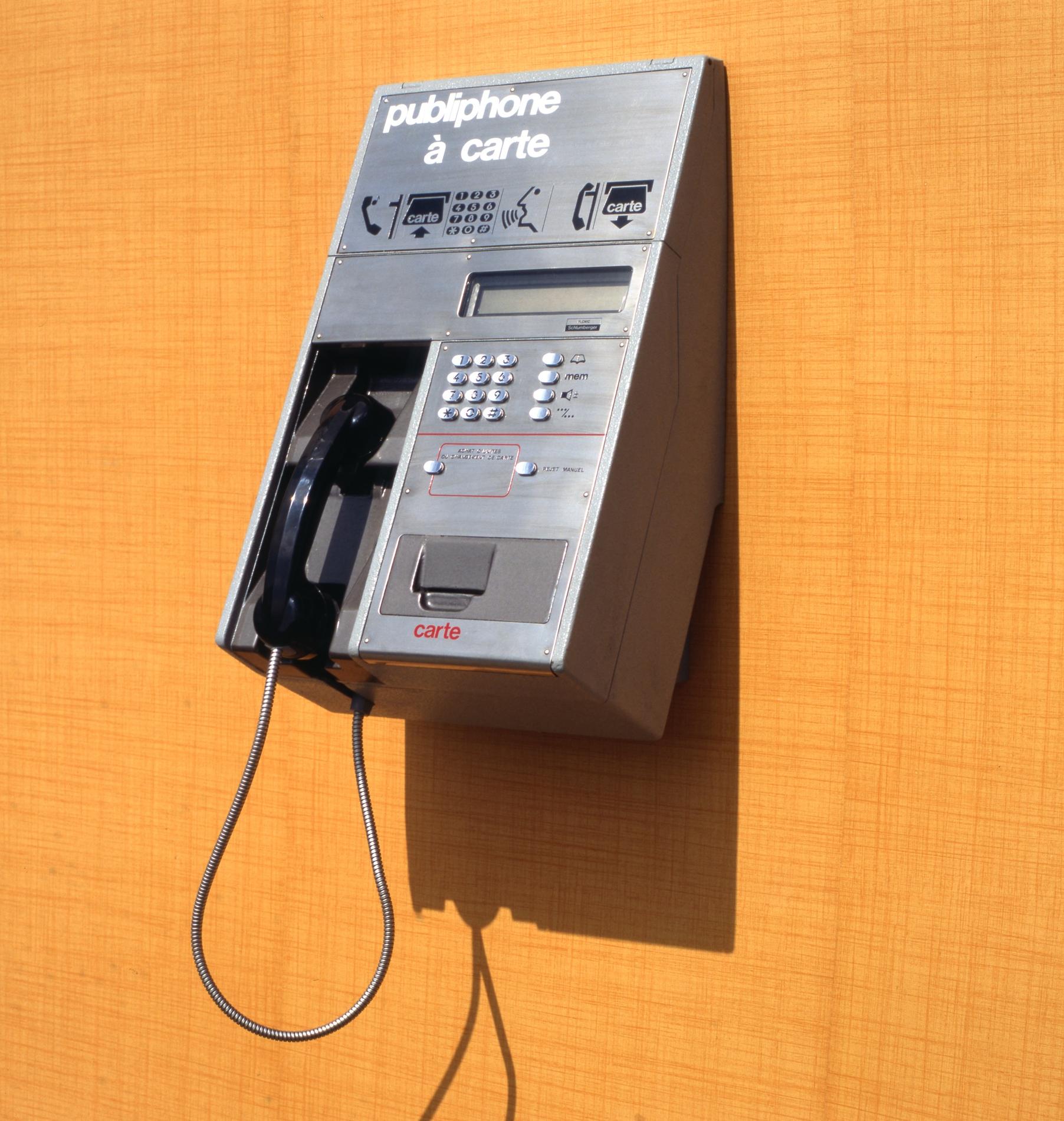
| Name | PF32 Publiphone à Carte |
| Date | 1984 |
| Manufacturer | Flonic-Schlumberger The first Schlumberger card phone for France Telecom |


Development of the PF32 Publiphone à Carte
| The first generation of French prepaid card payphones, introduced in 1984, marked a major technological shift in public telephony. These interurban publiphones, initially homologated by the PTT and later by France Télécom, were semi-analog and semi-digital devices designed to modernise public access to long-distance communication. A defining feature of these early models was the inclusion of a non-backlit liquid crystal display, which showed call credit in real time—an innovation for the period. They also offered amplified listening, improving accessibility for users in noisy environments. The principal model of this generation was the PF32, manufactured by Flonic-Schlumberger. The earliest PF32 units were trialled in Lyon on 15 June 1983, before being rolled out nationally from 1984, with approximately 25,000 units deployed across France. In Paris, the first installations began in January 1985 at major transport hubs such as Gare de Lyon and Gare Montparnasse, reflecting a strategy of targeting high-traffic locations. A key technical feature of the PF32 was its motorised card reader, which fully ingested the Télécarte to prevent fraud from tampered cards. However, this system proved problematic in practice. Under heavy usage, internal batteries struggled to recharge quickly enough, leading to frequent card jams. As a result, from January 1991, the motorised reader was replaced with a fixed reader design, significantly improving reliability. Weighing 17 kilograms, the PF32 also required a complex power setup: two separate telephone pairs delivering 48 volts (or up to 96 volts over long lines), meaning a four-wire system. This requirement ultimately limited its long-term viability, as later second-generation models achieved similar functionality using a simpler two-wire, 96-volt configuration. |
| More info- https://www.publiphonie.fr/ |
Leave a Reply