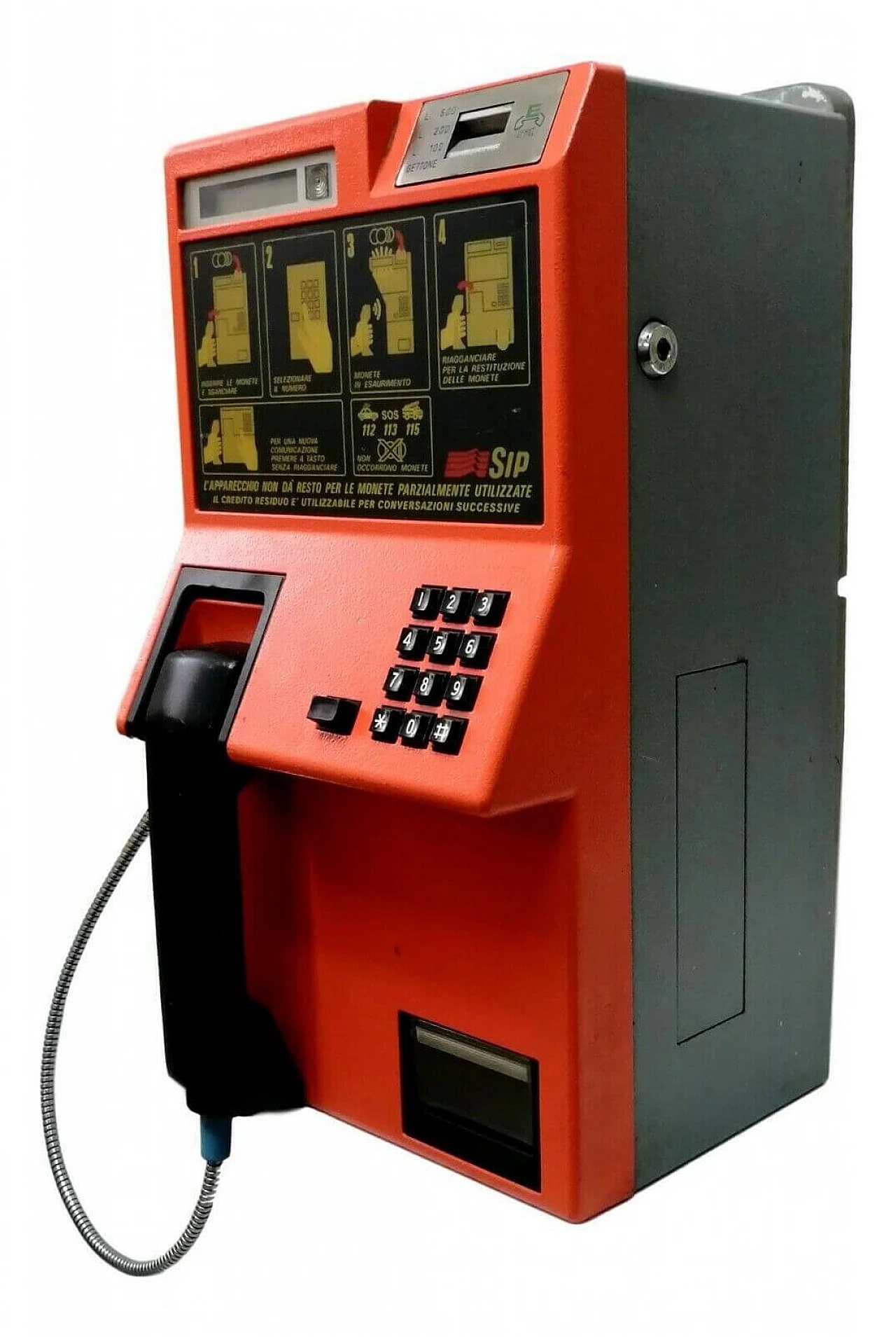
| Name | ROTOR Italian payphone |
| Date | 1990 |
| Manufacturer | IPM (Industria Politecnica Meridionale) S.p.A for Telecom Italia |
| Links | British Interphone kiosks using old Rotor phones in London in 2000 |
| South African Rotor payphones |


Above- wall mounted 1990 ROTOR Italian payphone
Development of the 1990 ROTOR Italian payphone
The Rotor was the most important Italian public payphone of the late twentieth century and the standard street telephone used throughout Italy from 1987 until about 2002. Introduced by SIP (Società Italiana per l’Esercizio Telefonico) and later operated by Telecom Italia, it replaced the earlier U+I and G+M generations, marking Italy’s transition from electromechanical payphones to fully electronic public telephony.
The Rotor was developed by the Naples-based manufacturer IPM (Industria Politecnica Meridionale) to SIP specifications and was later produced by both IPM and the Turin telecommunications company Urmet, with some components supplied by Sime Telefonia. Its industrial designer was Rodolfo Bonetto, one of Italy’s most influential post-war designers, known for his work in consumer electronics, transport and telecommunications.
A key feature of the Rotor was its modular electronic architecture. SIP envisaged it as a future-proof platform capable of evolving as telecommunications technology changed. The basic design could be adapted to accept coins, gettone telefonico tokens, prepaid telephone cards and later electronic payment systems, while also supporting remote monitoring, fault reporting and other advanced services. This flexibility allowed the Rotor to evolve through multiple versions without requiring a complete redesign.
Designed for heavy public use, the Rotor featured a robust anti-vandal housing, electronic call accounting and remote diagnostics. It gained a reputation for exceptional security and was regarded by enthusiasts as a payphone that was “never defeated by phreakers,” inspiring modern reverse-engineering projects.
Thousands were installed in railway stations, airports, city streets, village squares and motorway service areas, becoming one of the defining symbols of 1990s Italy. Although never officially adopted by British Telecom, a small number later appeared in the United Kingdom through private operators and imported installations, achieving only limited success. The Rotor was eventually replaced by the Digito from 2002, but remains one of Europe’s most significant public telephone designs.


Above- 1990 ROTOR Italian payphone”
Below- a gallery of Rodolfo Bonetto chunky Brutalist modular designs


Rodolfo Bonetto (1929–1991) was one of Italy’s leading industrial designers, known for combining advanced technology with bold, functional forms. His design philosophy emphasised simplicity, ergonomics and manufacturability while giving products a strong visual identity. Working across electronics, vehicles and telecommunications, Bonetto sought to make complex technology accessible and intuitive. His designs often featured sculptural forms, modular construction and durable materials, reflecting both practicality and the optimistic technological spirit of post-war Italian design.
Leave a Reply