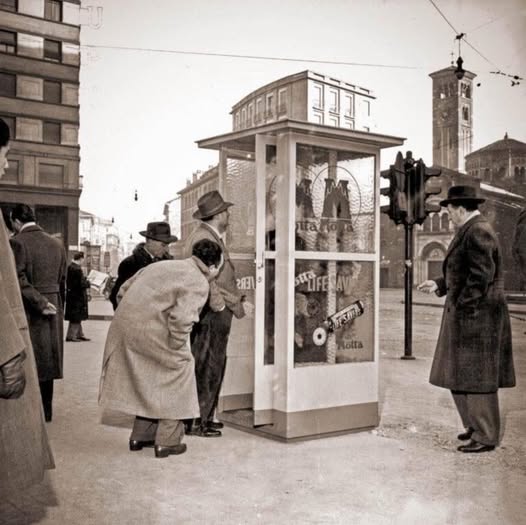
| Name | PRIMA MILAN first Italian Cabinet |
| Date | 1952 |
| Manufacturer | The first Milan telephone booths of 1952 were installed by STIPEL (Società Telefonica Interregionale Piemontese e Lombarda), the company responsible for Lombardy. Milan was chosen because it was Italy’s leading industrial and financial centre and had one of the country’s highest demands for telephone services. |
Below- the PRIMA MILAN cabinet as held in the amazing Museo Telefonia Pubblica (MTP) in Alberi di Vigatto (Parma), Italy. The Public Telephony Museum is the first museum in the world dedicated to Payphones.
Website- https://www.museotelefoniapubblica.com/


Above- the first cabinet installed in Milan in 1952. Wide scale cabinet installation would not happen until the early sixties.
Development of the PRIMA MILAN first Italian Cabinet
The first modern public telephone booth installed in Italy after the Second World War appeared in Milan in 1952, marking an important step in rebuilding the nation’s communications network. During the war, much of Italy’s telephone infrastructure had been damaged by military occupation and years of underinvestment. Telephone exchanges, cables and public call facilities required extensive reconstruction before reliable service could be restored.
In the immediate post-war years, Italy’s telephone system was operated through a number of regional concessionary companies under state supervision. Economic recovery during the late 1940s and early 1950s created increasing demand for telecommunications from businesses, government agencies and the public. As urban centres recovered, telephone companies sought to expand access by installing public telephones in streets, railway stations and major public spaces.
Italy did not have a single national telephone company immediately after the Second World War. Instead, the network was operated by several regional concessionaires under the supervision of the state telecommunications authority.
The origins of the system lay with the Azienda di Stato per i Servizi Telefonici (ASST), established in 1925. ASST directly operated long-distance trunk lines and some local networks, while private concessionary companies managed most local telephone services. After the war, the Italian government rebuilt the damaged network through this mixed public-private structure.
By the early 1950s, the principal operating companies included STIPEL (Piedmont and Lombardy), TELVE (Veneto), TIMO (central Italy), TETI (southern Italy and Sicily), and SET (north-western regions). These companies expanded local exchanges, installed new cables, and introduced public telephone booths as Italy’s economy recovered.
The first Milan telephone booths of 1952 were installed by STIPEL (Società Telefonica Interregionale Piemontese e Lombarda), the company responsible for Lombardy. Milan was chosen because it was Italy’s leading industrial and financial centre and had one of the country’s highest demands for telephone services.
In 1964 the government consolidated the various regional operators into a single national company, Società Italiana per l’Esercizio Telefonico (SIP). SIP became Italy’s unified telephone operator and oversaw the massive expansion of public telephones and booths throughout the 1960s, 1970s and 1980s. In 1994 SIP became part of Telecom Italia, which later inherited the country’s public telephone network.
Thus, the first post-war booths in Milan were installed under STIPEL, but the nationwide public telephone system most Italians remember was developed and operated by SIP.
Above-
Leave a Reply