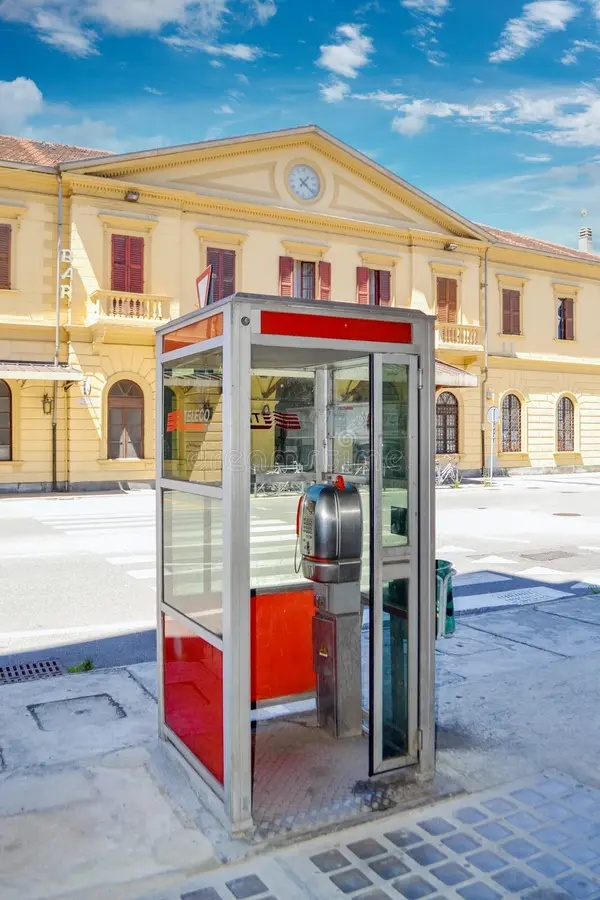
| Name | SIP Italian Cabinet- Italian aluminium booth |
| Date | 1965 first aluminium model. L72 model (1972) has two equal doors L79 model (1979) has two different doors and is 15cm wider than the L72. Note- The L72 and L79 were originallyfit out with yellow glass. In 1984 the SIP changed its corporate colour from yellow to red and sunsequently updated the colour scheme of the booths. |
| Manufacturer | Società Italiana per l’Esercizio Telefonico (SIP). |
| Link | The US Airlight booth of 1954, a possible inspiration for this design. See also- https://www.museotelefoniapubblica.com/ |


Above- the SIP Italian Cabinet. Wide scale cabinet installation would started to happen in the early sixties.
Development of the TETI Italian Cabinet
The TETI public telephone cabinet was one of the most recognisable elements of Italy’s post-war telecommunications network.
Introduced around 1962, the cabinet reflected the practical needs of the era. Italy’s expanding economy and increasing urbanisation created demand for reliable public communications. The TETI cabinet was therefore designed as a compact, durable structure that could be installed on streets, in squares, near railway stations, and in commercial districts. Its robust steel frame and extensive glazing provided protection from weather while maintaining visibility and safety for users.
The design was based strongly on American examples (the Airlight booth) and followed modernist principles common in post-war Italian industrial design`. Clean lines, functional detailing, and efficient use of materials allowed the cabinet to be manufactured economically while presenting a modern image for the country’s rebuilding telecommunications network. The transparent walls also helped reduce vandalism and improved user security.


Above-


Above- the booth on left is the first model from 1972 and is called the L72 (it has two equal doors).
The above one on the right is the second model from 1979 and is called the L79. It has two different doors and is larger (15cm) than the L72.
Information with special thanks to the amazing Museo Telefonia Pubblica (MTP) in Alberi di Vigatto (Parma), Italy.
Website- https://www.museotelefoniapubblica.com/
Below- This is the 1965 model, the first produced under the SIP period. And it is produced by PROSIDER (Roma)

Below- The limited edition bright red version of this Telecom Italia telephone kiosk was produced to commemorate the Great Jubilee of the Year 2000 (Grande Giubileo del 2000), one of the most significant events in the modern history of the Catholic Church. Proclaimed by Pope John Paul II, the Jubilee attracted around 25 million pilgrims to Rome and other Italian pilgrimage centres during 2000. The sign “telefono” on the top glass like the first 1965 Booth of sip a special edition reed L79 made in 2000. From the collection of the Museo Telefonia Pubblica (MTP) in Alberi di Vigatto (Parma), Italy.

Leave a Reply