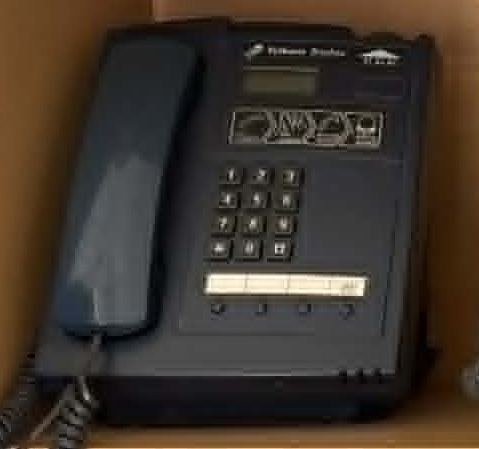
| Name | Telkom Tetabox |
| Date | c. 1990 |
| Manufacturer | Telkom SA (based on the Solitaire Payphone, United Kingdom) |

Information and images with special thanks to Mark Van Der Heever and Peter Van Almelo
Development of the TETABOX PAYPHONE (Late 1990s)
Introduced in the late 1990s, the Tetabox was one of Telkom South Africa’s final supervised tabletop payphones, designed for installation in shops, cafés, community centres and other attended public locations. Its name was derived from the Xhosa word teta, meaning “chat.” Unlike traditional public payphones, the Tetabox connected to an ordinary analogue telephone line, making installation inexpensive and practical for private operators.
Operating on the prepayment principle, the Tetabox accepted only South Africa’s newer coin denominations, including the R1, R2 and R5 coins. Owners could program call tariffs to suit their business, allowing the payphone to recover costs or generate income while providing a valuable public service. Electronic call control ensured reliable operation, while its compact, durable design reduced maintenance requirements compared with conventional street payphones.
The Tetabox reflected Telkom’s strategy of expanding affordable public telephone access through privately managed, supervised locations during the final years before mobile phones became widespread. The design was closely related to the Solitaire Payphone, which was marketed in the United Kingdom and Australia, demonstrating how proven international payphone technology was adapted to South African operating conditions and currency requirements. It was among the last generation of coin-operated payphones introduced before mobile telephony rapidly displaced public telephone services.


Leave a Reply