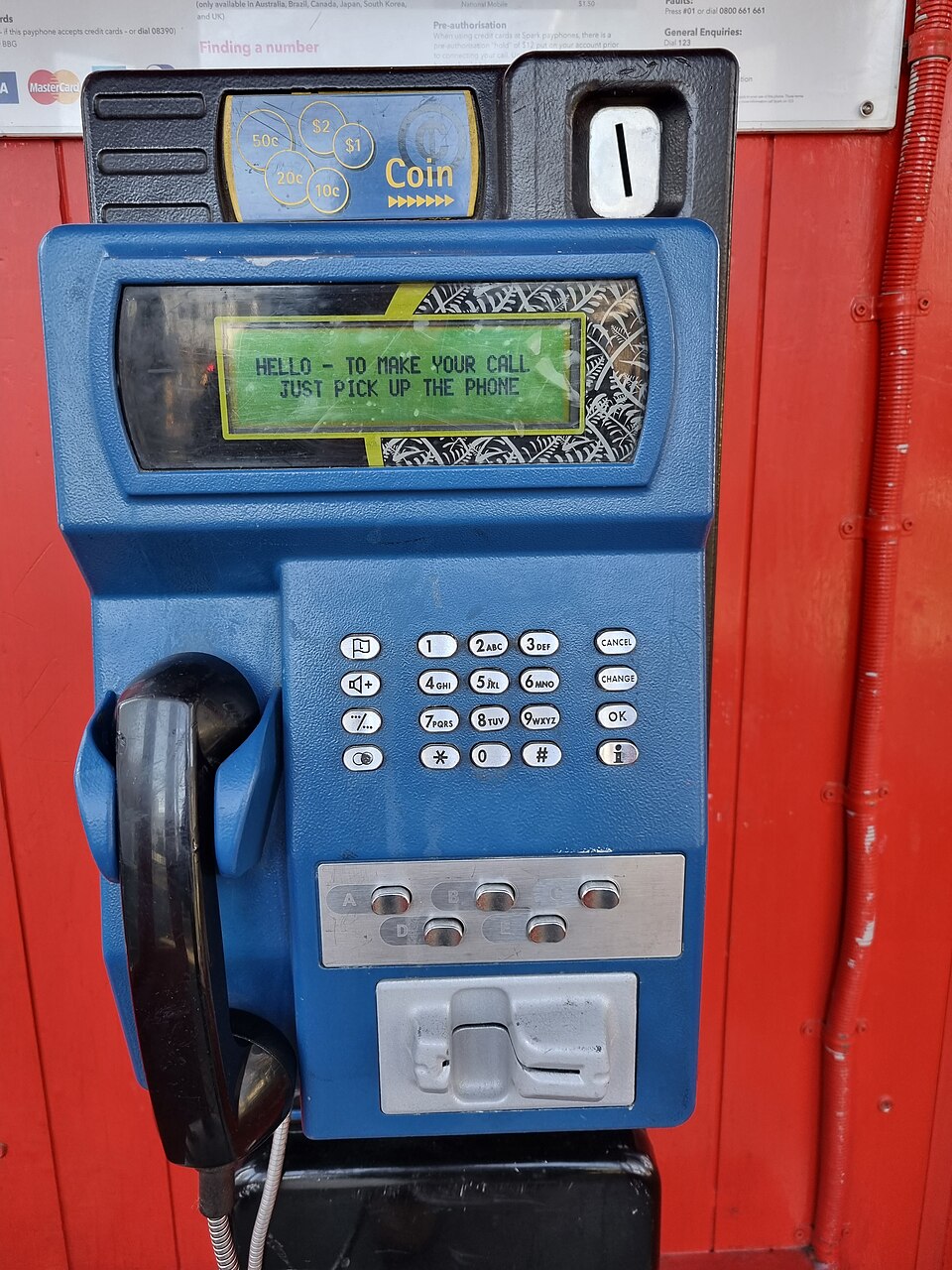
| Name | Ascom Cardphone (belongs to Ascom’s Payphone 2000 family) Ascom Monétel SA, type Payphone 705 |
| Date | Telecom New Zealand undertook the rollout of 6,500 of these new blue payphones in August 1999, replacing the CT24A fleet. Some are still in use in 2026. |
| Manufacturer | Manufactured by Ascom in Switzerland The same hardware platform was sold to TELMEX (Mexico) and almost certainly other operators with different branding. |


NZ Ascom Public Payphone
Introduced in 1999, the Ascom public payphone marked a new generation of telecommunications equipment in New Zealand. Manufactured by the Swiss telecommunications company Ascom, it replaced the ageing CT24A payphones with a modern, software-controlled platform designed for international deployment. Telecom New Zealand installed approximately 6,500 of these distinctive blue payphones nationwide, making them the country’s standard public telephone throughout the 2000s.
The Ascom payphone featured a large backlit dot-matrix LCD display, a modern alphanumeric keypad, programmable function buttons and support for multiple payment methods. Depending on the configuration, it accepted coins, chip phonecards, Telecom Calling Cards, TalkAway cards, credit cards and debit cards. Instructions could be displayed in several languages, including English, Māori, Samoan, Tongan and Japanese, while larger keys, improved displays and hearing-aid compatibility made the telephone more accessible to users with disabilities.
Unlike earlier payphones, the Ascom platform was entirely software driven, allowing tariffs, services and operating features to be updated remotely. The same basic hardware was also supplied to overseas operators, including TELMEX in Mexico, demonstrating its success as a versatile international design. In New Zealand these payphones remained in widespread service for more than two decades, gradually evolving to support cashless payments before many were converted to free local calling and eventually phased out as mobile phone use became universal.


Below- same Asom model in use in Mexico (beige colour)
In 1999, Ascom secured a major contract to replace Telecom New Zealand’s entire public payphone network with approximately 6,000 chip-card payphones, complete with an off-line management system. New Zealand became only the second country, after Hungary, to implement Ascom’s comprehensive anti-fraud security system for chip cards. The contract was valued at 45 million French francs. During the same period, Ascom expanded its presence throughout Latin America, supplying 7,000 Proxim card payphones to the national telecommunications operators of Guatemala and El Salvador, building on earlier installations in Mexico, Colombia and Argentina.


Leave a Reply