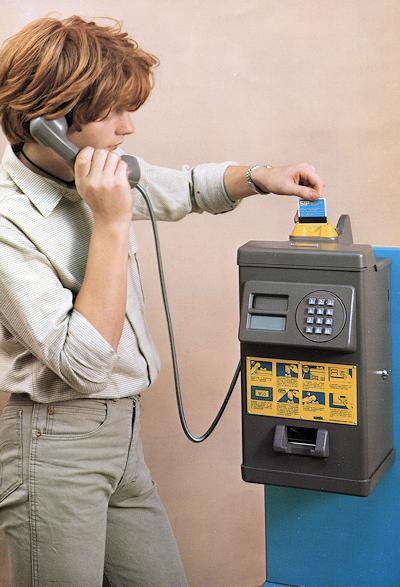
| Name | SIDA SMT-08 Magnetic Card Payphone |
| Date | 1976. The world’s first public payphone system to use prepaid magnetic telephone cards (prototype) |
| Manufacturer | The payphone was manufactured by SIDA S.p.A. (Società Italiana Distributori Automatici), a company founded in 1970 in Montichiari, near Brescia, by entrepreneur Luciano Lorenzini. SIDA was not originally a telecommunications manufacturer; instead, it specialised in the design and production of automatic vending machines. |
| See also phonecard history link- https://allcards.phonecardshop.net/en/history-of-italian-cards-the-yellow-blue-sida/ | The below prototype of the world’s first card phone is in the collection of the Museo Telefonia Pubblica (MTP) in Alberi di Vigatto (Parma), Italy. Website- https://www.museotelefoniapubblica.com/ |


Development of the SIDA SMT-08 payphone
The SIDA SMT-08 represents one of the most important milestones in the history of public telecommunications. Developed by SIDA S.p.A. of Montichiari, near Brescia, Italy, and introduced in 1976, it is widely regarded as the world’s first public payphone system to use prepaid magnetic telephone cards in a real street trial. While magnetic card technology had been demonstrated experimentally at the 1975 Telecom ’75 exhibition in Geneva by Landis & Gyr using Spanish test cards, the Italian SIDA system was the first to place prepaid card telephones into everyday public service, allowing ordinary members of the public to make calls without coins.
The SMT-08 was produced for Italy’s national telephone operator SIP (Società Italiana per l’Esercizio Telefonico) as part of a pioneering field trial. The best-known installation was at the underground car park of Villa Borghese (Galoppatoio) in Rome, where a bank of card-operated telephones was installed in May 1976 alongside conventional token and coin-operated telephones. Approximately 25 card telephones were initially supplied, with additional units installed at several other locations, including the Guglielmo Reiss Romoli telecommunications school in L’Aquila.
Unlike later systems that employed plastic magnetic-stripe cards, the SIDA system used paper cards laminated with a thin plastic coating. The magnetic information was stored in a unique transverse magnetic slurry band running across the card rather than on a conventional magnetic stripe. Around 300,000 SIDA 0 cards were produced for the trial, although almost all were recovered after use. The telephones retained each card internally, allowing SIP engineers to analyse wear, reliability and security before supervising their destruction. As a result, surviving examples are exceptionally scarce today.
Internally, the SMT-08 combined sophisticated electromechanical engineering with emerging microelectronic control. The card reader validated the magnetic coding, while electronic circuitry deducted the prepaid credit and controlled call connection. The system proved the practicality of prepaid telephony, eliminating the need for coins and simplifying payment for both domestic and international calls.
The success of the SIDA trial directly influenced the development of more secure plastic magnetic-stripe phonecards, and later optical and smart-card technologies. Although the SIDA magnetic cards themselves were short-lived, the SMT-08 demonstrated that prepaid telephone cards were commercially viable. It therefore occupies a unique position in telecommunications history as the first publicly deployed prepaid card payphone system, marking the beginning of the worldwide transition from coin-operated telephones to electronic card-operated public telephony.


The payphone was manufactured by SIDA S.p.A. (Società Italiana Distributori Automatici), a company founded in 1970 in Montichiari, near Brescia, by entrepreneur Luciano Lorenzini. SIDA was not originally a telecommunications manufacturer; instead, it specialised in the design and production of automatic vending machines for hot and cold beverages, building on earlier experience under the name SELME. The company developed expertise in mechanical engineering, electronics, coin validation and automated payment systems. During the early 1970s, SIDA devised an innovative magnetic-card payment system intended initially for vending machines rather than telephones. Recognising the potential of cashless payment, SIP collaborated with SIDA to adapt the technology for public telephony, resulting in the world’s first practical prepaid magnetic card payphone. Following the success of the 1976 field trial, SIDA became SIP’s principal supplier of magnetic card telephones and also manufactured automatic dispensers for telephone tokens and prepaid phonecards, remaining closely involved with the Italian telephone card programme until the mid-1990s. In later years the company expanded into a wide range of automated dispensing equipment, including cigarette vending machines, parking payment systems, ticket dispensers, pharmaceutical vending machines and other self-service kiosks.
Below-

Leave a Reply