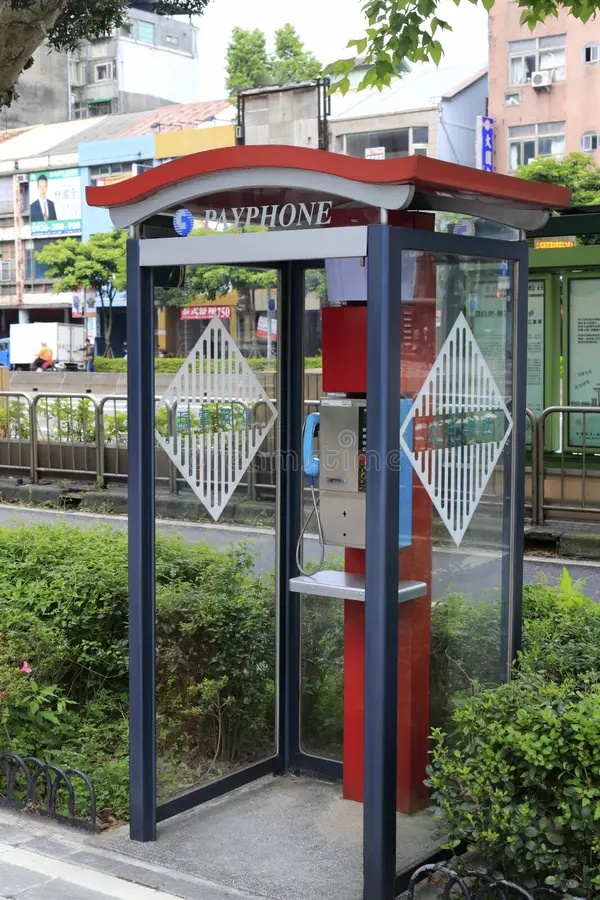
| Name | Taiwan Phone Booths |
| Date | C. 1970 – 2020 |
| Manufacturer | The DGT/Chunghwa Telecom produced the booth design in-house and tendered manufacture to different contractors over time. |


Development of the Taiwan Tongya CIC-168
The modern Taiwanese public telephone booth is one of the country’s most recognisable pieces of late-20th century street furniture. Introduced during the 1990s by Chunghwa Telecom as older open payphone installations were replaced, the design combines a compact steel frame with large tempered glass panels, providing weather protection while maintaining good visibility for personal safety. Its distinctive gently curved red roof became a standard feature across Taiwan, appearing in cities, suburban streets, railway stations and tourist areas. The booths were designed to accommodate successive generations of telephones without major structural changes, from coin-operated models to IC card, smart card and later multi-function payphones. Many were also fitted with emergency call capability, public information notices and, in later years, Wi-Fi equipment, allowing the booths to remain useful even as payphone use declined.
Unlike the fully enclosed British or Japanese kiosks, Taiwan’s booth is semi-open, providing excellent ventilation in the island’s hot, humid climate while reducing vandalism and maintenance costs. The open front also allows wheelchair access and makes the telephone clearly visible from the street. Although mobile phones have greatly reduced demand, hundreds of these booths remain in service, particularly at transport hubs, hospitals and government facilities, where they provide reliable communications during emergencies and natural disasters. Their combination of practical engineering, distinctive architecture and adaptability has made them an enduring symbol of Taiwan’s public telecommunications network, surviving long after many other countries removed their traditional phone booths.


The first generation of modern Taiwanese telephone booths appeared during the late 1970s and became widespread throughout the 1980s and early 1990s, accompanying the rapid expansion of the island’s public telephone network. Built by the Directorate General of Telecommunications (DGT), many housed payphones manufactured by Tongya Telephone Co. and other domestic suppliers. Unlike the later open-sided shelters, these booths were more fully enclosed, using aluminium or painted steel frames with large glass panels and hinged glass doors to provide protection from rain, traffic noise and the humid subtropical climate.
Several variations existed. Early examples were finished in white or cream with a distinctive red fascia carrying the words 公用電話 (“Public Telephone”) in white Chinese characters. Later versions adopted bright yellow frames to improve visibility and pedestrian safety. Multiple booths were often installed together outside railway stations, post offices, department stores and busy commercial streets, reflecting the enormous demand for public telephones before mobile phones became common.
The booths were designed to accommodate successive generations of equipment, from rotary and push-button coin telephones to electronic, IC card and smart card models introduced during the late 1980s and 1990s. Most included an internal shelf for writing or placing coins and personal belongings, while some accessible versions provided wider entrances for wheelchair users.
During the late 1990s these enclosed booths were gradually replaced by the distinctive red-roofed semi-open shelters introduced by Chunghwa Telecom. Better ventilated, cheaper to maintain and easier to supervise, the newer design proved better suited to Taiwan’s climate and changing patterns of public telephone use, although a small number of the older booths survive in isolated locations today.


Leave a Reply