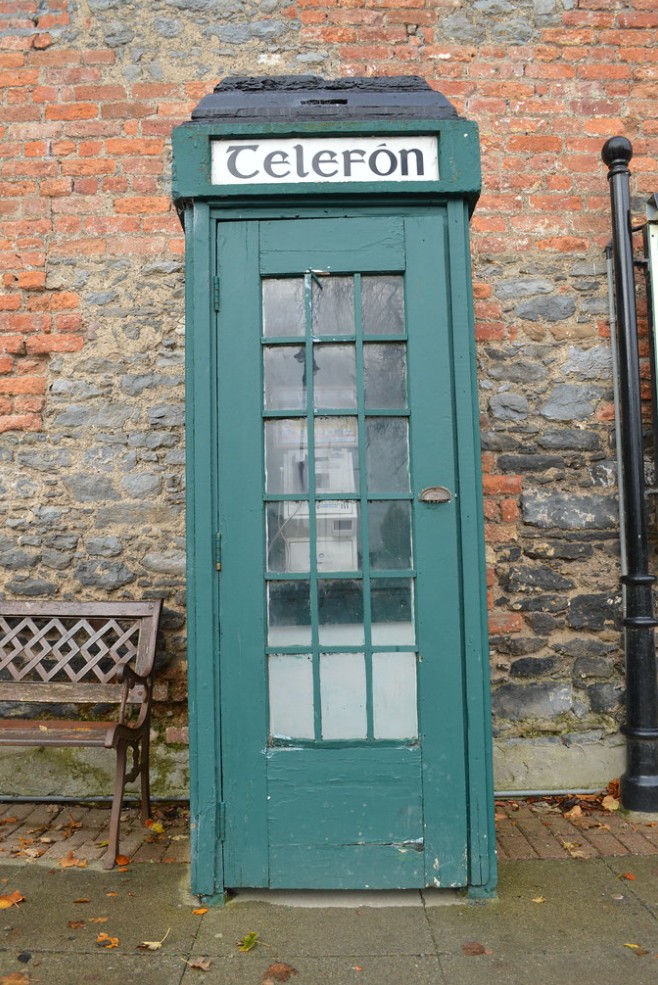
| Name | Irish P&T Concrete Telephone Kiosk |
| Date | C. 1930 – 50 |
| Manufacturer | P&T |


Development of the P&T Concrete Telephone Kiosk
Following Irish independence, the Department of Posts and Telegraphs (P&T) developed its own distinctive telephone kiosks rather than adopting the British GPO’s later K2 and K6 cast-iron designs. The familiar Irish kiosk is generally described in contemporary heritage records simply as the P&T telephone kiosk, P&T “Telefón” kiosk, or concrete-and-timber telephone kiosk; I have found no reliable evidence that P&T officially designated it “K6”, “K7” or by another British-style K-number.
The earliest post-independence version appears to have been timber construction. Photographs of the 1932 Eucharistic Congress in Dublin show P&T kiosks of this type, suggesting that the characteristic Irish design was established by the early 1930s. A later and much more durable version used mass-produced moulded/precast concrete wall sections and cap, with timber-framed glazing and a timber glazed door. Railway modelling research based on measured examples calls it the “P & T Telephone Box – Cast Concrete and Timber version.”
The concrete kiosk appears to have become widespread from approximately the 1940s/1950s. The National Inventory of Architectural Heritage dates the surviving Chapelizod example to c.1950 and describes its square plan, moulded concrete construction, three-by-six-pane glazing, “Telefón” fascia panels and P & T lettering moulded into the lower walls. Surviving examples and records occur throughout the Republic, including Chapelizod, Enniskerry, Timoleague, Castletownshend and other towns and villages.
Originally associated with the P&T’s green-and-cream livery, many were subsequently repainted in Telecom Éireann blue and white after telecommunications were transferred from P&T in 1984. The concrete kiosks remained a familiar part of Ireland’s telephone network into the 1980s and beyond, before progressively being replaced by modern metal kiosks.
Manufacturer: this remains uncertain. Although the kiosks were clearly a standardised, mass-produced P&T design, I have not yet found a dependable primary source identifying the precast-concrete manufacturer, nor evidence of an official model number. I would therefore avoid attributing them to a particular company until a P&T drawing, contract or supplier catalogue can be located.


Below- The precast concrete K1 (Kiosk No. 1) was developed by the British GPO in 1921–22 as its first standard telephone kiosk. However, Irish examples appear to have been installed after independence: the oldest documented Irish K1 was installed in Dublin in 1925, under the new Irish P&T. Constructed in concrete, K1s were subsequently installed at several Irish locations (but painted green). Interestingly, the concept of precast concrete phone boxes caught on in Ireland. It was used but abandoned in other Commonwealth countries in the 20s.


Below- The K6 was not officially adopted by the Irish P&T, which instead used its own concrete-and-timber kiosks. K6s seen in the Republic appear largely to be later private imports. A notable green-painted example survives at Kinsale, County Cork, although heritage records date it to around 1950 (no crown).


Below- a K8 in use. Not sure how this ended up in the Republic.

Leave a Reply